
A totally reflecting, small plane mirror placed horizontally faces a parallel beam of light as shown in figure. The mass of the mirror is 20g. Assume that there is no absorption in the lens and that 30% of the light emitted by the source goes through the lens. Find the power of the source needed to support the weight of the mirror. Take g = 10 m s–2.

The weight of the mirror is supported by the light.
The weight of mirror =mg.
Force exerted on mirror is, as mirror is fully reflecting and 30% of light which is passed through the lens is used
From equation 1 of question 6 we can write

we light fall at angle θ on mirror
taking derivative of above equation and putting θ =0 as perpendicular it is falling we get

Where  =power and
  =force ,c =speed of light.
∴ we get
Force = 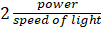
∴ The force exerted by light is = 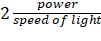 .
.
And the power of light which is used is only 30% of original
→ for mirror to be in equilibrium the downward force and upward force must be equal.
The weight acting downwards = the force exerted by light
Weight acting downwards =Mg
Force exerted by light=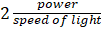
As only 30% of light is fall on mirror, therefore only 30% of the power is in use.
Force exerted by light=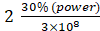

Where M= mass,
g = acceleration due to gravity.
Putting the values,
20× × 10=2
  .
.
Hence, power is = =100MW.
Couldn't generate an explanation.
Generated by AI. May contain inaccuracies — always verify with your textbook.