Q29 of 69 Page 365

In the arrangement shown in figure y = 1.0 mm, d = 0.24 mm and D = 1.2 m. The work function of the material of the emitter is 2.2 eV. Find the stopping potential V needed to stop the photocurrent.


Given, y=1mm

Fringe width y=2× 1 =2mm


d=0.24mm


D =1.2m


Work function Ф =2.2eV


We know that fringe width


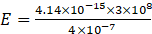
Putting the values in above equation we get,
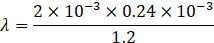


We also know that


[h=]


From Einstein’s photoelectric equation,


Stopping potential


More from this chapter

All 69 →
27

A silver ball of radius 4.8 cm is suspended by a thread in a vacuum chamber. Ultraviolet light of wavelength 200 nm is incident on the ball for some time during which a total light energy of 1.0 × 10⁻⁷ J falls on the surface. Assuming that on the average one photon out of every ten thousand is able to eject a photoelectron, find the electric potential at the surface of the ball assuming zero potential at infinity. What is the potential at the centre of the ball?

28

In an experiment on photoelectric effect, the emitter and the collector plates are placed at a separation of 10 cm and are connected through an ammeter without any cell figure.


A magnetic field B exists parallel to the plates. The work function of the emitter is 2.39 eV and the light incident on it has wavelengths between 400 nm and 600 nm. Find the minimum value of B for which the current registered by the ammeter is zero. Neglect any effect of space charge.


30

In a photoelectric experiment, the collector plate is at 2.0 V with respect to the emitter plate made of coper (ϕ = 4.5 eV). The emitter is wavelength 200 nm. Find the minimum and maximum kinetic energy of the photoelectrons reaching the collector.

31

A small piece of cesium metal (ϕ = 1.9 eV) is kept at a distance of 20 cm from a large metal plate having a charge density of 1.0 × 10⁻⁹ C m–2 on the surface facing the cesium piece. A monochromatic light of wavelength 400 nm is incident on the cesium piece. Find the minimum and the maximum kinetic energy of the photoelectrons reaching the large metal plate. Neglect any change in electric field due to the small piece of cesium present.