Q49 of 55 Page 61

In the following questions a statement of Assertion (A) followed by a statement of Reason (R) is given. Choose the correct option out of the choices given below each question.

Assertion (A): Liquids tend to have maximum number of molecules at their surface.


Reason (R): Small liquid drops have spherical shape.


(i) Both A and R are true and R is the correct explanation of A.


(ii) Both A and R are true but R is not the correct explanation of A.


(iii) A is true but R is false.


(iv) A is false but R is true.


iv) A is false but R is true.


Liquids tend to reduce the number of molecules or their surface tension at their surface because at the surface there are unbalanced attractive forces at the surface of liquid which tends to pull the molecules back into the bulk liquid leaving the minimum number of molecules on the surface or decreasing the surface tension due to this reason or that’s why small drops have spherical shape. So, A is false and R is true.


More from this chapter

All 55 →
47

In the following questions a statement of Assertion (A) followed by a statement of Reason (R) is given. Choose the correct option out of the choices given below each question.

Assertion (A): Gases do not liquefy above their critical temperature, even on applying high pressure.


Reason (R): Above critical temperature, the molecular speed is high and intermolecular attractions cannot hold the molecules together because they escape because of high speed.


(i) Both A and R are true and R is the correct explanation of A.


(ii) Both A and R are true but R is not the correct explanation of A.


(iii) A is true but R is false.


(iv)A is false but R is true.


48

In the following questions a statement of Assertion (A) followed by a statement of Reason (R) is given. Choose the correct option out of the choices given below each question.

Assertion (A): At critical temperature liquid passes into gaseous state imperceptibly and continuously


Reason (R): The density of liquid and gaseous phase is equal to critical temperature.


(i) Both A and R are true and R is the correct explanation of A.


(ii) Both A and R are true but R is not the correct explanation of A.


(iii) A is true but R is false.


(iv) A is false but R is true


50

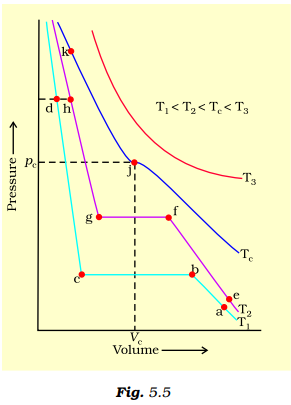
Isotherms of carbon dioxide at various temperatures are represented in Fig. 5.5. Answer the following questions based on this figure.

(i) In which state will CO2 exist between the points a and b at temperature T1?


(ii) At what point will CO2 start be liquefying when temperature is T1?


(iii) At what point will CO2 be completely liquefied when temperature is T2.


(iv) Will condensation take place when the temperature is T3.


(v) What portion of the isotherm at T1represent liquid and gaseous CO2 at equilibrium?


51

The variation of vapour pressure of different liquids with temperature is shown in Fig. 5.6.

(i) Calculate graphically boiling points of liquids A and B.


(ii) If we take liquid C in a closed vessel and heat it continuously. At what temperature will it boil?


(iii) At high altitude, atmospheric pressure is low (say 60 mm Hg). At what temperature liquid D boils?


Pressure cooker is used for cooking food at hill station. Explain in terms of vapour pressure why is it so?


(iv) Pressure cooker is used for cooking food at hill station. Explain in terms of vapour pressure why is it so?