Q38 of 66 Page 149

“Stability of carbocation depends upon the electron releasing inductive effect of groups adjacent to positively charged carbon atom involvement of neighbouring groups in hyper-conjugation and resonance.”

Write structures of various carbocation that can be obtained from 2-methylbutane. Arrange these carbocation in order of increasing stability.


There are four possible carbocation structures for 2-methylbutane. And they are:


Now, the stability order is found to be:


(III) > (II) > (I) > (IV)


This is because (III) is tertiary carbocation, (II) is secondary carbocation, (I) and (IV) are primary, but as the number of alpha hydrogen in (I) is more than that of (IV) (as more number of alpha hydrogen leads to more stability of carbocation; in hyper-conjugation.)


More from this chapter

All 66 →
36

“Stability of carbocation depends upon the electron releasing inductive effect of groups adjacent to positively charged carbon atom involvement of neighbouring groups in hyper-conjugation and resonance.”

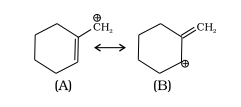
Which of the following ions is more stable? Use resonance to explain your answer.


37

“Stability of carbocation depends upon the electron releasing inductive effect of groups adjacent to positively charged carbon atom involvement of neighbouring groups in hyper-conjugation and resonance.”

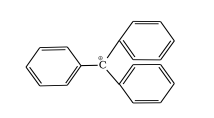
The structure of triphenylmethylcation is given below. This is very stable and some of its salts can be stored for months. Explain the cause of high stability of this cation.


39

Three students, Manish, Ramesh and Rajni were determining the extra elements present in an organic compound given by their teacher. They prepared the Lassaigne’s extract (L.E.) independently by the fusion of the compound with sodium metal. Then they added solid FeSO4 and dilute sulphuric acid to a part of Lassaigne’s extract. Manish and Rajni obtained Prussian blue colour but Ramesh got red colour. Ramesh repeated the test with the same Lassaigne’s extract, but again got red colour only. They were surprised and went to their teacher and told him about their observation. Teacher asked them to think over the reason for this. Can you help them by giving the reason for this observation. Also, write the chemical equations to explain the formation of compounds of different colours.

40

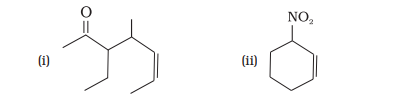
Name the compounds whose line formulae are given below: