Q24 of 31 Page 6

Fig. 1.11 shows the electric field lines around three point charges A, B and C.

(a) Which charges are positive?


(b) Which charge has the largest magnitude? Why?


(c) In which region or regions of the picture could the electric field be zero? Justify your answer.


(i) near A, (ii) near B, (iii) near C, (iv) nowhere.


a) We know that electric field lines starts from +ive charge and terminates at –ive charge , As we can see in the fig it is starting from Charge A and C , So charge A and C are positive.


b) The charge C has the largest magnitude as we can see the electric field line are still remaining after terminating at point charge B and the electric field lines of C is deflecting the electric field lines of A, So charge C has the largest magnitude.


Using the principle no. of electric field lines associated with the charge is proportional to magnitude of charge.


c) (i) near A, the electric field be zero because as the charge A and C have same positive nature and Charge C has higher magnitude so, The Line joining the charge A and C ,and close to A will have zero electric field.


More from this chapter

All 31 →
22

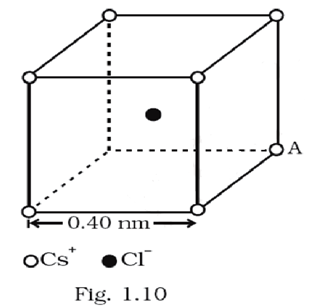
Fig. 1.10 represents a crystal unit of cesium chloride, CsCl. The cesium atoms, represented by open circles are situated at the corners of a cube of side 0.40nm, whereas a Cl atom is situated at the centre of the cube. The Cs atoms are deficient in one electron while the Cl atom carries an excess electron.


(i) What is the net electric field on the Cl atom due to eight Cs atoms?


(ii) Suppose that the Cs atom at the corner A is missing. What is the net force now on the Cl atom due to seven remaining Cs atoms?


23

Two charges q and –3q are placed fixed on x-axis separated by distance ‘d’. Where a third charge 2q should be placed such that it will not experience any force?

25

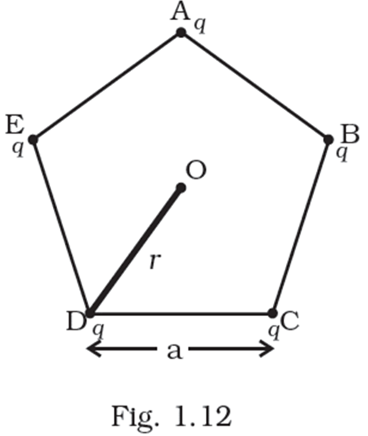
Five charges, q each are placed at the corners of a regular pentagon of side ‘a’ (Fig. 1.12).


(a) (i) What will be the electric field at O, the center of the pentagon?


(ii) What will be the electric field at O if the charge from one of the corners (say A) is removed?


(iii) What will be the electric field at O if the charge q at A is replaced by –q?


(b) How would your answer to (a) be affected if pentagon is replaced by n-sided regular polygon with charge q at each of its corners?


26

In 1959 Lyttleton and Bondi suggested that the expansion of the Universe could be explained if matter carried a net charge. Suppose that the Universe is made up of hydrogen atoms with a number density N, which is maintained a constant. Let the charge on the proton be: ep = – (1 + y)e where e is the electronic charge.

(a) Find the critical value of y such that expansion may start.


(b) Show that the velocity of expansion is proportional to the distance from the Centre.