Q27 of 31 Page 7

Consider a sphere of radius R with charge density distributed as

ρ(r) = kr for r ≤ R


= 0 for r >R .


a) Find the electric field at all points r.


(b) Suppose the total charge on the sphere is 2e where e is the electron charge. Where can two protons be embedded such that the force on each of them is zero. Assume that the introduction of the proton does not alter the negative charge distribution.


For E for r ≤ R


We know the integral form of gauss theorem which is


As the electric field vector and surface area vector are as shown in


fig 1.27 b


For ,


Let, dv be a small volume component,


Since the gaussian surface is spherical,


k


As shown in fig 1.27 a Gaussian surface is inside the actual sphere


for r≤ R


Now for r >R.


Gaussian surface will be outside the actual sphere


And Qenc will be fixed


Now,


for r >R .


b) The two protons should be kept at equal distance from the Centre of sphere so that the attractive force on both of them is same. As depicted in the fig 1.27 c


Charge on the sphere; As found in previous part.


And according to question i.e = 2e


Now as we can see there will be two type of forces on a proton, one attractive force due to negative charge distribution on sphere and repulsive due to other proton.


One attractive force due to negative charge distribution on sphere;


; as we found for r ≤ R


Fattractive -----eq.1


Substituting the value of k in eq.1


We get F attractive


And repulsive due to other proton.


By applying coulombs law i.e. k


So, F repulsive


Or, F repulsive


Net force on proton will be zero if F attractive + F repulsive =0


More from this chapter

All 31 →
25

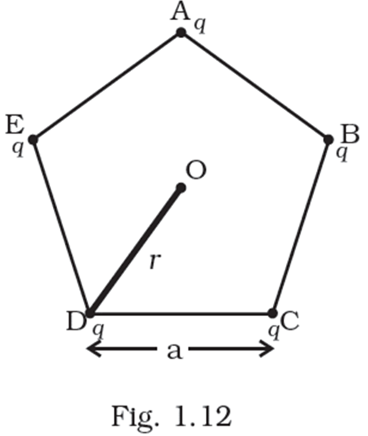
Five charges, q each are placed at the corners of a regular pentagon of side ‘a’ (Fig. 1.12).


(a) (i) What will be the electric field at O, the center of the pentagon?


(ii) What will be the electric field at O if the charge from one of the corners (say A) is removed?


(iii) What will be the electric field at O if the charge q at A is replaced by –q?


(b) How would your answer to (a) be affected if pentagon is replaced by n-sided regular polygon with charge q at each of its corners?


26

In 1959 Lyttleton and Bondi suggested that the expansion of the Universe could be explained if matter carried a net charge. Suppose that the Universe is made up of hydrogen atoms with a number density N, which is maintained a constant. Let the charge on the proton be: ep = – (1 + y)e where e is the electronic charge.

(a) Find the critical value of y such that expansion may start.


(b) Show that the velocity of expansion is proportional to the distance from the Centre.


28

Two fixed, identical conducting plates (α &β) , each of surface area S are charged to –Q and q, respectively, where Q > q > 0. A third identical plate (), free to move is located on the other side of the plate with charge q at a distance d (Fig 1.13). The third plate is released and collides with the plate β. Assume the collision is elastic and the time of collision is sufficient to redistribute charge amongst


(a) Find the electric field acting on the plate before collision.


(b) Find the charges on β and after the collision.


(c) Find the velocity of the plate after the collision and at a distance d from the plate β.


29

There is another useful system of units, besides the SI/mksA system, called the cgs (centimeter-gram-second) system. In this system Coloumb’s law is given by Frr =

where the distance r is measured in cm (= 10–2 m), F in dynes (=10–5 N) and the charges in electrostatic units (es units), where 1es unit of charge 9 1 10 C [3] − = ×


The number [3] actually arises from the speed of light in vaccum which is now taken to be exactly given by c = 2.99792458 × 10⁸ m/s. An approximate value of c then is c = [3] × 108 m/s.


(i) Show that the coloumb law in cgs units yields


1 esu of charge = 1 (dyne)1/2 cm.


Obtain the dimensions of units of charge in terms of mass M, length L and time T. Show that it is given in terms of fractional powers of M and L.


(ii) Write 1 esu of charge = x C, where x is a dimensionless number. Show that this gives


9 2 2 2 0 1 10 N.m 4x C π − =


With , we have 9 1 x 10 [3] − = ×


2 2 9 2 0 1 Nm [3] 10 4C π = ×


Or, (exactly) 2 2 9 2 0 1 Nm [2.99792458] 10 4C π = ×