Q29 of 30 Page 1

(i) Consider a conductor of resistance ‘R’, length ‘L’, thickness’ d’ and resistivity ‘ρ’. Now this conductor is cut into four equal parts. What will be the new resistivity of each of these parts? Why?

(ii) Find the resistance if all of these parts are connected in:


(a) Parallel


(b) Series


(iii) Out of the combinations of resistors mentioned above in the previous part, for a given voltage which combination will consume more power and why?


(i) Let the initial resistance be R


Length be L


Thickness be d and


Resistivity be ρ


Now resistivity is given by


When the resistance is cut into 4 equal pieces, then the cross sectional area remains same before and after.


Hence resistivity becomes-


Hence, resistivity remains same.


(ii)When all parts are connected in series, then equivalent resistance,


Now the length of each part becomes, L/4 and resistivity and Area of cross section remains same, then-


(iii)When all resistors are connected in parallel-


(iii)Power loss in a resistor in form of heat is given by is given by


Where,


i = is the current flowing through it.


Hence, power loss is in direction proportion to resistance which means more resistance, more power loss.


Hence, resistors in series will consume more power than parallel.


More from this chapter

All 30 →
26

The formulae of four organic compounds are given below:


(i) Which one of these compounds A, B, C or D is a saturated hydrocarbon?


(ii) Identify the organic acid and give its structural formula.


(iii) Which ofthe above compounds when heated at 443K in the presence of concentrated forms ethene as the major product? What is the role played byconcentrated in this reaction? Also write the chemical equationinvolved.


(iv) Give a chemical equation when B and C react with each other


in presence of concentrated. Name the major product formed andmention one of its important use.


27


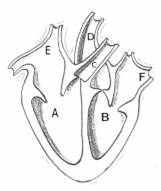
(i) Identify any two parts from the above diagram which carry oxygenated and deoxygenated blood.


(ii) Explain the process of double circulation with the help of a flow chart


28

(i) Describe the various steps involved in the process of binary fission with the help of a diagram.

(ii) Why do multicellular organisms use complex way of reproduction?


OR


(i) Describe the role of prostate gland, seminal vesicle and testes in the human male reproductive system.


(ii) How is the surgical removal of unwanted pregnancies misused?


(iii) Explain the role of oral contraceptive pills in preventing conception.


30

(i) A lens produces a magnification of -0.5. Is this a converging or diverging lens? If the focal length of the lens is 6 cm, draw a ray diagram showing the image formation in this case.

(ii) A girl was playing with a thin beam of light from a laser torch by directing it from different directions on a convex lens held vertically. She was surprised to see that in a particular direction, the beam of light continues to move along the same direction after passing through the lens. State the reason for her observation. Draw a ray diagram to support your answer.


OR


(i) On entering in a medium from air, the speed of light becomes half of its value in air. Find the refractive index of that medium with respect to air?


(ii) A glass slab made of a material of refractive index n1 is kept in a medium of refractive index n2.


A light ray is incident on the slab. Draw the path of the rays of light emerging from the glass slab, if (i) n1> n2 (ii) n1 = n2 (iii) n1< n2