Q24 of 26 Page 1

(a) Derive the expression for the potential energy of an electric dipole of dipole moment placed in a uniform electric field .

Find out the orientation of the dipole when it is in (i) stable equilibrium, (ii) unstable equilibrium.


(b) Figure shows a configuration of the charge array of two dipoles. Obtain the expression for the dependence of potential on r for r >> a for a point P on the axis of this array of charges.


OR


(a)Define electric flux. Write its S.I. unit.


(b)Using Gauss’s law, obtain the electric flux due to a point charge ‘q’ enclosed in a cube of side ‘a’.


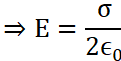
(c)Show that the electric field due to a uniformly charged infinite plane sheet at any point distant x from it, is independent of x.


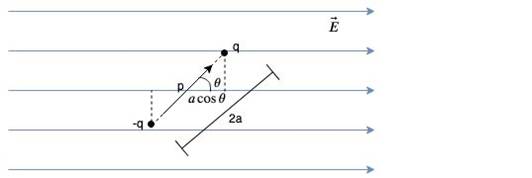
(a) The following figure shows an electric dipole with charges and separated by a distance in a electric field .


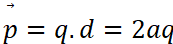
The dipole moment is given by


Now, the torque on the dipole is



Therefore, work done by this torque in rotating the dipole is



Now, let and
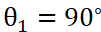


Now, for stable equilibrium,


And unstable equilibrium gives


(b) From the figure it is evident that the potential at point P is due to three charges.



Where potential is given by where , q is the charge and r is the distance of the point from the charge.



Now for


OR


(a) Electric flux is the amount of electric field crossing a given area or the integral of electric field over a given surface. Mathematically,



(b) The gauss law states that the total flux crossing a surface is directly proportional to the amount of electric charge held within the surface.
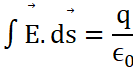


Here, the charge enclosed by the cube is q. Therefore, the flux is


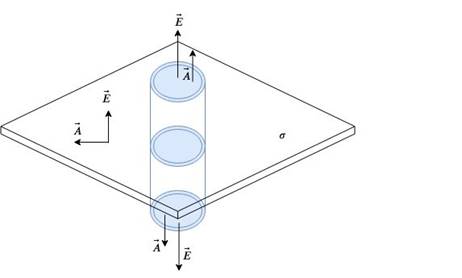
(c) To calculate flux, we create a hypothetical Gaussian pill box through the surface. The area of the face of the cylinder is while the electric field is .


The area and the field are at right angles throughout the surface of the cylinders except the faces.


Hence in the curved surface area, the flux is


At either side, the flux is



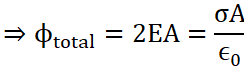
Total flux thus becomes (due to the two surfaces)
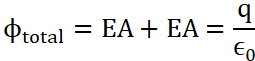


So the electric field has no dependence on distance, and only depends on the charge density of the sheet.


More from this chapter

All 26 →
22

Define the electric resistivity of a conductor.

Plot a graph showing the variation of resistivity with temperature in the case of a (a) conductor, (b) semiconductor.


Briefly explain, how the difference in the behavior of the two can be explained in terms of number density of charge carriers and relaxation time.


23 SECTI

Asha’s uncle was advised by his doctor to have an MRI (magnetic resonance imaging) scan of his brain. Her uncle felt that it was too expensive and wanted to postpone it. When Asha learnt about this, she took the help of her family and when she approached the doctor, he also offered a substantial discount. She thus convinced her uncle to undergo the test to enable the doctor to know the condition of his brain. The resulting information greatly helped his doctor to treat him properly.

Based on the above paragraph, answer the following questions:


(a)What according to you are the values displayed by Asha, her family and the doctor?


(b)What in your view could be the reason for MRI test to be so expensive?


(c)Assuming that MRI test was performed using a magnetic field of 0 �1 T, find the maximum and minimum values of the force that the magnetic field could exert on a proton (charge = ) that was moving with a speed of .


25

(a) Define a wavefront.

(b) Using Huygens’ principle, draw the diagrams to show the nature of the wavefronts when an incident plane wavefront gets


(i)reflected from a concave mirror,


(ii)refracted from a convex lens.


(c) Draw a diagram showing the propagation of a plane wavefront from denser to a rarer medium and verify Snell’s law of refraction.


OR


(a)A concave mirror produces a real and magnified image of an object kept in front of it. Draw a ray diagram to show the image formation and use it to derive the mirror equation.


(b)A beam of light converges at a point P. Now a lens is placed in the path of the convergent beam 12 cm from P. At what point does the beam converge if the lens is


(i)a convex lens of focal length 20 cm,


(ii)a concave lens of focal length 16 cm?


26

(a) Describe, with the help of a suitable diagram, how one can demonstrate that emf can be induced in a coil due to the change of magnetic flux. Hence state Faraday’s law of electromagnetic induction.

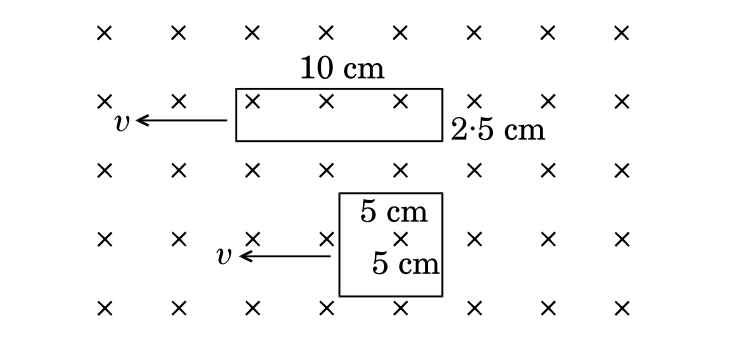
(b) Two loops, one rectangular of dimensions 10 cm x 2 �5 cm and second of square shape of side 5 cm are moved out of a uniform magnetic field perpendicular to the planes of the loops with equal velocity as is shown in the figure.


(i)In which case will the emf induced be more?


(ii)In which case will the current flowing through the two loops be less?


Justify your answer.


OR


(a)State the principle of an a.c. generator.


(b)Explain briefly, with the help of labelled diagram, its working and obtain the expression for the emf generated in the coil.


(c)Draw a schematic diagram showing the nature of the alternating emf generated by the rotating coil in the magnetic field during one cycle.