
(a) Describe, with the help of a suitable diagram, how one can demonstrate that emf can be induced in a coil due to the change of magnetic flux. Hence state Faraday’s law of electromagnetic induction.
(b) Two loops, one rectangular of dimensions 10 cm x 2 �5 cm and second of square shape of side 5 cm are moved out of a uniform magnetic field  perpendicular to the planes of the loops with equal velocity
  as is shown in the figure.
(i)In which case will the emf induced be more?
(ii)In which case will the current flowing through the two loops be less?
Justify your answer.
OR
(a)State the principle of an a.c. generator.
(b)Explain briefly, with the help of labelled diagram, its working and obtain the expression for the emf generated in the coil.
(c)Draw a schematic diagram showing the nature of the alternating emf generated by the rotating coil in the magnetic field during one cycle.
(a) The following diagram illustrates emf being induced in a coil due to a moving magnet. Moving a magnet changes the magnetic flux through the loop. Changing flux induces magnetic field.
When the south pole of the magnet moves towards the coil, a south pole in induced by the current flowing in the loop. Similarly, when the magnet moves away from the coil, a north pole is induced in the loop.
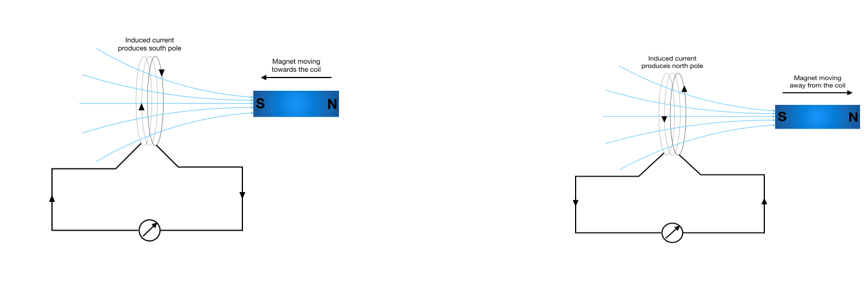
The emf ( ) induced in the coil is related to theS magnetic flux(
 ) as:
) as:

(b) We know that the emf ( ) induced in the coil is related to the magnetic flux(
 ) as:
) as:

Here, magnetic flux is

Where x in the length of the wire and y is the breadth.
As the coil is moved out, the length changes according the velocity as


(i)Now, velocity of both loops is same but the breadth y of square loop is more than that of rectangular loop. Hence, the emf induced will be more in square loop.
(ii) As rectangular loop has higher resistance (more wire length) than the square loop, the current would be less in the rectangular loop.
However, as the field is constant and the loops are moving within the field region, there will be no emf induced in either loops.
OR
(a) AC generator is a device which converts mechanical energy into electrical energy in form of alternating current(AC). AC generator works on the principle of electromagnetic induction. As the coil, placed in between the two poles of the magnet, rotates, the changing area induces a current in the coil.
(b) The following diagram illustrates an AC generator.
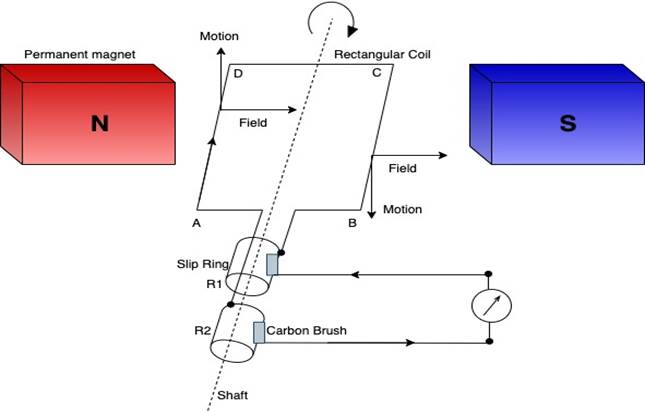
Here, the coil is mechanically rotated at angular velocity  . The angle between the area vector A and the magnetic field B changes as

Now, the magnetic flux is given by

Therefore, the induced emf for a coil of N turns is


(c) The following diagram shows the induced emf as time propagates.
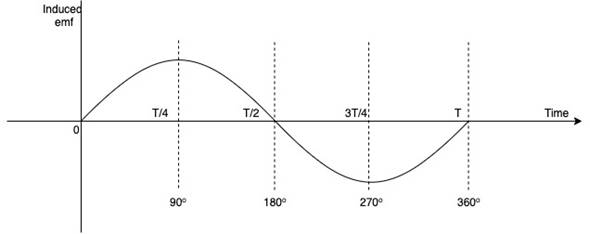
Couldn't generate an explanation.
Generated by AI. May contain inaccuracies — always verify with your textbook.


