Skip to content
Philoid
Browse Saved
Back to chapter
Maths
17. Understanding Shapes-III (Special Types of Quadrilaterales)
Home · Class 8 · Maths · Ref. Book · 17. Understanding Shapes-III (Special Types of Quadrilaterales)
Prev
Next
Q27 of 58 Page 18

Diagonals of a parallelogram ABCD intersect at O. AL and CM are drawn perpendiculars to BD such that L and M lie on BD. Is AL = CM? Why or why not?
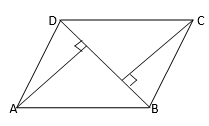

AL and CM are perpendiculars on diagonal BD.


AL = CM [In a parallelogram length of perpendiculars drawn on diagonal from opposite vertices are equal]


More from this chapter

All 58 →
25

Diagonals of parallelogram ABCD intersect at O as shown in Fig. 17.30. XY contains O, and x,Y are points on opposite sides of the parallelogram. Give reasons for each of the following:

26

In Fig. 17.31, ABCD is a parallelogram, CE bisects ∠C andAF bisects ∠A. In each of the following, if the statement is true, give a reason for the same.

28

Points E and F lie on diagonals AC of a parallelogram ABCD such that AE = CF. What type of quadrilateral is BFDE?

29

In a parallelogram ABCD, AB = 10cm, AD = 6 cm. The bisector of ∠A meets DC in E, AE and BC produced meet at F. Find the length CF.

Questions · 58
17. Understanding Shapes-III (Special Types of Quadrilaterales)
1 2 3 4 5 6 7 8 9 10 11 12 13 14 15 16 17 18 19 20 21 22 23 24 25 26 27 28 29 1 2 3 4 5 6 7 8 9 10 11 12 13 14 1 2 3 4 5 6 7 8 9 10 11 12 13 14 15
Back to chapter
ADVERTISEMENT
About Contact Privacy Terms
Philoid · 2026
  • Home
  • Search
  • Browse
  • Quiz
  • Saved