Skip to content
Philoid
Browse Saved
Back to chapter
Maths
17. Understanding Shapes-III (Special Types of Quadrilaterales)
Home · Class 8 · Maths · Ref. Book · 17. Understanding Shapes-III (Special Types of Quadrilaterales)
Prev
Next
Q4 of 58 Page 17

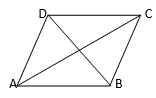
The diagonals of a quadrilateral are perpendicular to each other. Is such a quadrilateral always a rhombus? If your answer is ‘No’, draw a figure to justify your answer.

No it is not always a rhombus.


More from this chapter

All 58 →
2

Fill in the blanks, in each of the following, so as to make the statement true:

(i) A rhombus is a parallelogram in which _______.


(ii) A square is a rhombus in which _________.


(iii) A rhombus has all its sides of ______ length.


(iv) The diagonals of a rhombus _____ each other at ______ angles.


(v) If the diagonals of a parallelogram bisect each other at right angles, then it is a ______.

3

The diagonals of a parallelogram are not perpendicular. Is it a rhombus? Why or why not?

5

ABCD is a rhombus. If ∠ACB = 40°, find ∠ADB.

6

If the diagonals of a rhombus are 12 cm and 16 cm, find the length of each side.

Questions · 58
17. Understanding Shapes-III (Special Types of Quadrilaterales)
1 2 3 4 5 6 7 8 9 10 11 12 13 14 15 16 17 18 19 20 21 22 23 24 25 26 27 28 29 1 2 3 4 5 6 7 8 9 10 11 12 13 14 1 2 3 4 5 6 7 8 9 10 11 12 13 14 15
Back to chapter
ADVERTISEMENT
About Contact Privacy Terms
Philoid · 2026
  • Home
  • Search
  • Browse
  • Quiz
  • Saved