Q12 of 17 Page 156

Fig. 13.15 shows the distance-time graph for the motion of two vehicles A and B. Which one of them is moving faster?


Distance – Time graph for a motion of two cars

Vehicle A is moving faster than vehicle B as according to the graph given in the above figure, the slope of graph A is more than slope of graph B. It is clear from the above graph. That more distance has been travelled by the vehicle A in lesser time and therefore, the speed will be more than vehicle B.


More from this chapter

All 17 →
10

A car moves with a speed of 40 km/h for 15 minutes and then with a speed of 60 km/h for the next 15 minutes. The total distance covered by the car is:

i. 100 km ii. 25 km


iii. 15 km iv. 10 km

11

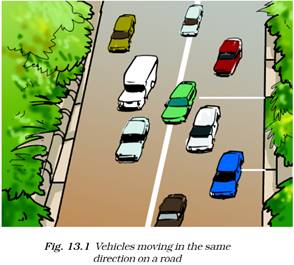
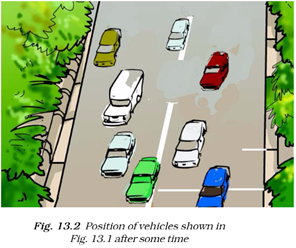
Suppose the two photographs, shown in Fig. 13.1 and Fig. 13.2, had

been taken at an interval of 10 seconds. If a distance of 100 metres is shown by 1 cm in these photographs, calculate the speed of the blue car.


13

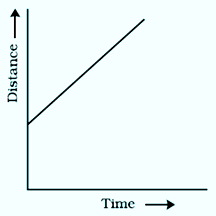
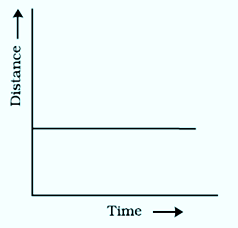
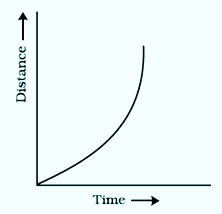
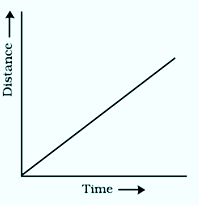
Which of the following distance-time graphs shows a truck moving with speed which is not constant?

(i)


(ii)


(iii)


(iv)

1

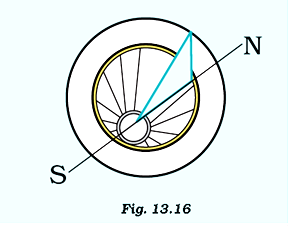
You can make your own sundial and use it to mark the time of the day at your place. First of all find the latitude of your city with the help of an atlas. Cut out a triangular piece of a cardboard such that its one angle is equal to the latitude of your place and the angle opposite to it is a right angle. Fix this piece, called gnomon, vertically along a diameter of a circular board a shown in Fig. 13.16. One way to fix the gnomon could be to make a groove along a diameter on the circular board.

Next, select an open space, which receives sunlight for most of the day. Mark a line on the ground along the North-South direction. Place the sundial in the sun as shown in Fig. 13.16. Mark the position of the tip of the shadow of the gnomon on the circular board as early in the day as possible, say 8:00 AM. Mark the position of the tip of the shadow every hour throughout the day. Draw lines to connect each point marked by you with the centre of the base of the gnomon as shown in Fig. 13.16. Extend the lines on the circular board up to its periphery. You can use this sundial to read the time of the day at your place. Remember that the gnomon should always be placed in the North-South direction as shown in Fig. 13.16.