Q1 of 34 Page 9

Why are farm labourers like Dala and Ramkali poor?

Dala and Ramkali are poor farm labourers because, they don’t own any piece of land for farming, and just work on daily wages. Also, they get far less wages than the minimum daily wages decided by the government. The government has decided the minimum wages for a farm labourer Rs. 60 per day, but they only get Rs. 35-40. People tend to work for lower wages to earn their livelihood, which makes the competition heavy for work among farm labourers.


More from this chapter

All 34 →
1

Would you agree that the distribution of cultivated land is unequal in Palampur? Do you find a similar situation for India? Explain.

5

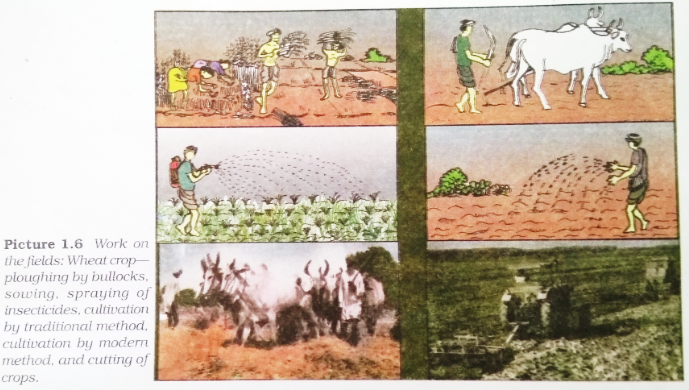
Identify the work being done on the field in the pictures (given below) and arrange them in a proper sequence.


1. Cutting of crops


2. Spraying of insecticides


3. Cultivation by traditional method


4. Ploughing the field by bullock.


5. Sowing


6. Cultivation by modern method.

2

Gosaipur and Majauli are two villages in north Bihar. Out of a total of 850 households in the two villages, there are more than 250 men, who are employed in rural Punjab and Haryana or in Delhi, Mumbai, Surat, Hyderabad or Nagpur. Such migration is common in most villages across India. Why do people migrate? Can you describe (based on your imagination) the work that the migrants of Gosaipur and Majauli might do at the place of destination.

1

Let us take three farmers. Each has grown wheat on his field, though the production is different (see Column 2). The consumption of wheat by each farmer family is the same (Column 3). The whole of surplus of wheat this year is used as capital for next year's production. Also suppose production is twice the capital used in production.

Complete the tables.


Farmer 1


Production

Consumption

Surplus =
Production -
Consumption

Capital for the
next year

Year 1

Year 2

Year 3

100


120

40

40

40

60

-

-

60

-

-


Farmer 2


Production

Consumption

Surplus = 
Production -
Consumption

Capital for the
next year

Year 1

Year 2

Year 3

80

-

-

40

40

40

-

-

-

-

-

-

Farmer 3


Production

Consumption

Surplus =
Production -
Consumption

Capital for the
next year

Year 1

Year 2

Year 3

60

-

-

40

40

40

-

-

-

-

-

-