
If the sum of first n, 2n and 3n term of an AP be S1 , S2 and S3 respectively, then prove that S3 = 3 (S2 – S1).
We know that sum of first n terms of an AP is

Where a is first term and d is common difference
So,
Sum of first 2n terms

Sum of first 3n terms

Now, Taking RHS



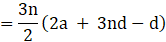

RHS = LHS
Hence Proved
AI is thinking…
Couldn't generate an explanation.
Generated by AI. May contain inaccuracies — always verify with your textbook.