Q24 of 28 Page 55

A boy standing on a stationary lift (open from above) throws a ball upwards with the maximum initial speed he can, equal to 49 m/s. How much time does the ball take to return to his hands? If the lift starts moving up with a uniform speed of 5 m/s and the boy again throws the ball up with the maximum speed he can, how long does the ball take to return to his hands?

Given,


Initial speed of the ball, u = 49 m/s


Acceleration, a = -g = -9.81 m/s2


Speed of the lift = 5 m/s


Case 1, Lift is stationary:


It resembles freely falling body. Thus, In upward motion final velocity, v = 0


From 1st equation of motion,


v = u + at


Where,


v = Final velocity


u = Initial velocity


a = Acceleration/Deceleration


t = Time


Time of ascent, t = s = s = 5 s


Total time of float = 2×Time of ascent = 10 s


Case 2, Lift is moving with velocity 5 m/s:


Even though, lift (boy) is moving with velocity 5 m/s the initial velocity also increased by 5 m/s. So, relative velocity of ball with respect to boy remains 49 m/s. Thus, Time of float = 10 s.


More from this chapter

All 28 →
22

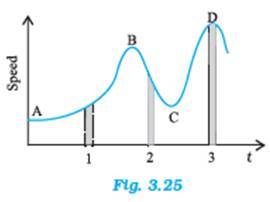
Figure 3.25 gives a speed-time graph of a particle in motion along a constant direction. Three equal intervals of time are shown. In which interval is the average acceleration greatest in magnitude? In which interval is the average speed greatest? Choosing the positive direction as the constant direction of motion, give the signs of v and a in the three intervals. What are the accelerations at the points A, B, C and D?

23

A three-wheeler starts from rest, accelerates uniformly with 1 m/s2 on a straight road for 10 s, and then moves with uniform velocity. Plot the distance covered by the vehicle during the nth second (n = 1,2,3….) versus n. What do you expect this plot to be during accelerated motion: a straight line or a parabola?

25

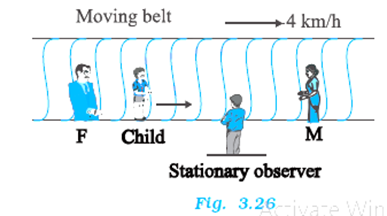
On a long horizontally moving belt (Fig. 3.26), a child runs to and fro with a speed 9 km/h (with respect to the belt) between his father and mother located 50 m apart on the moving belt. The belt moves with a speed of 4 km/h. For an observer on a stationary platform outside, what is the

(a) Speed of the child running in the direction of motion of the belt?


(b) Speed of the child running opposite to the direction of motion of the belt?


(c) Time taken by the child in (a) and (b)?


Which of the answers alter if motion is viewed by one of the parents?


26

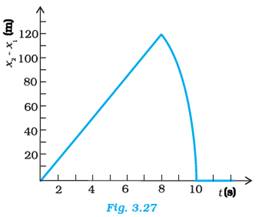
Two stones are thrown up simultaneously from the edge of a cliff 200 m high with initial speeds of 15 m/s and 30 m/s. Verify that the graph shown in Fig. 3.27 correctly represents the time variation of the relative position of the second stone with respect to the first. Neglect air resistance and assume that the stones do not rebound after hitting the ground. Take g = 10 m/s2. Give the equations for the linear and curved parts of the plot.