Q4 of 10 Page 239

Explain the difference between the Indian Constitution and western ideas in the light of

A. Understanding of secularism.


B. Articles 370 and 371.


C. Affirmative action.


D. Universal adult franchise.

A. Understanding Secularism:

In Indian Constitution government could intervene in religious matters if it hinders right of any individual or section Whereas in Western country like USA religion is completely away from government intervention.


B. Articles 370 and 371. Art 370 and 371 grant special status to Jammu and Kashmir and North Eastern states respectively. Both the states have their own regional conflicts and issues; hence the status is provided. Whereas in Western Country there is no such provision.


C. Affirmative action in India is based upon social justice and it was launched in India much before than it was in US.


D. Universal adult franchise, this idea is same in both India and western countries. Every citizen who is above 18 years can vote.


More from this chapter

All 10 →
2

Which of the options given below cannot be used to complete the following statement?

Democratic countries need a constitution to


i. Check the power of the government.


ii. Protect minorities from majority.


iii. Bring independence from colonial rule.


iv. Ensure that a long-term vision is not lost by momentary passions.


v. Bring social change in peaceful manner.

3

The following are different positions about reading and understanding Constituent Assembly debates.

i. Which of these statements argues that Constituent Assembly debates are relevant even today? Which statement says that they are not relevant?


ii. With which of these positions do you agree and why?


a. Common people are too busy in earning livelihood and meeting different pressures of life. They can’t understand the legal language of these debates.


b. The conditions and challenges today are different from the time when the Constitution was made. To read the ideas of Constitution makers and use them for our new times is trying to bring past in the present


c. Our ways of understanding the world and the present challenges have not changed totally. Constituent Assembly debates can provide us reasons why certain practises are important. In a period when constitutional practises are being challenged, not knowing the reasons can destroy them.

5

Which of the following principles of secularism are adopted in the Constitution of India?

A. that state will have nothing to do with religion


B. that state will have close relation with religion


C. that state can discriminate among religions


D. that state will recognise rights of religious groups


E. that state will have limited powers to intervene in affairs of religions

6

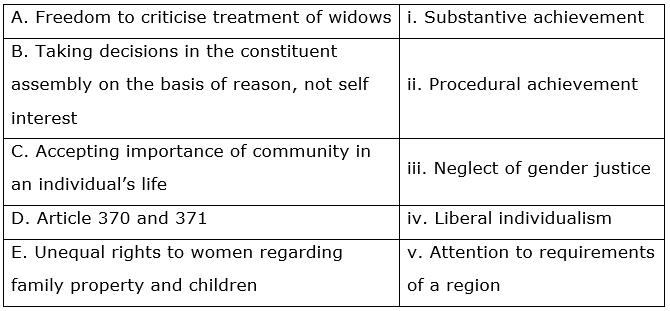
Match the following.