Q5 of 10 Page 239

Which of the following principles of secularism are adopted in the Constitution of India?

A. that state will have nothing to do with religion


B. that state will have close relation with religion


C. that state can discriminate among religions


D. that state will recognise rights of religious groups


E. that state will have limited powers to intervene in affairs of religions

The Principle of secularism are adopted in the Constitution of India:

D. that state will recognise rights of religious groups


E. that state will have limited powers to intervene in affairs of religions


The above principles are adopted because:


1. To safeguard the freedom of individuals.


2. To protect religious freedom of individuals, therefore, state must not help religious organisations.


3. This was because a person’s freedom and sense of self-respect was directly dependent upon the status of her community.


4. Religiously sanctioned customs such as untouchability deprived individuals of the most basic dignity and self-respect. Such customs were so deeply rooted and pervasive that without active state intervention, there was no hope of their dissolution. Thus, the state may help or hinder religious communities depending on which mode of action promotes values such as freedom and equality.


More from this chapter

All 10 →
3

The following are different positions about reading and understanding Constituent Assembly debates.

i. Which of these statements argues that Constituent Assembly debates are relevant even today? Which statement says that they are not relevant?


ii. With which of these positions do you agree and why?


a. Common people are too busy in earning livelihood and meeting different pressures of life. They can’t understand the legal language of these debates.


b. The conditions and challenges today are different from the time when the Constitution was made. To read the ideas of Constitution makers and use them for our new times is trying to bring past in the present


c. Our ways of understanding the world and the present challenges have not changed totally. Constituent Assembly debates can provide us reasons why certain practises are important. In a period when constitutional practises are being challenged, not knowing the reasons can destroy them.

4

Explain the difference between the Indian Constitution and western ideas in the light of

A. Understanding of secularism.


B. Articles 370 and 371.


C. Affirmative action.


D. Universal adult franchise.

6

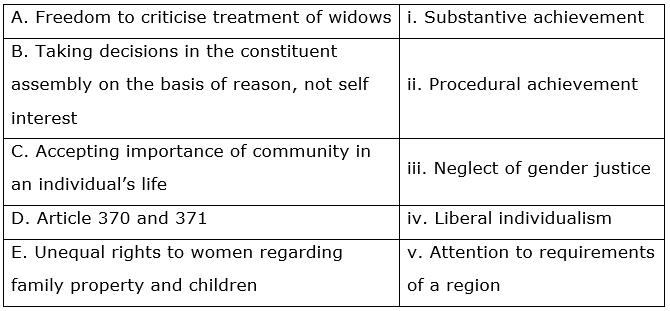
Match the following.

7

This discussion was taking place in a class. Read the various arguments and state which of these do you agree with and why.

Jayesh: I still think that our Constitution is only a borrowed document.


Saba: Do you mean to say that there is nothing Indian in it? But is there such a thing as Indian and western in the case of values and ideas? Take equality between men and women. What is western about it? And even if it is, should we reject it only because it is western?


Jayesh: What I mean is that after fighting for independence from the British, did we not adopt their system of parliamentary government?


Neha: You forget that when we fought the British, we were not against the British as such, we were against the principle of colonialism. That has nothing to do with adopting a system of government that we wanted, wherever it came from.