Skip to content
Philoid
Browse Saved
Back to chapter
Mathematics
7. Triangles
Home · Class 9 · Mathematics · NCERT - Mathematics · 7. Triangles
Next
Q1 of 31 Page 118

In quadrilateral ACBD,

AC = AD and AB bisects ∠ A (see Fig. 7.16). Show that Δ ABC ≅Δ ABD.


What can you say about BC and BD?


It is given in the question that:

AC = AD and,


AB bisects ∠A


To prove:


Proof: In


AB = AB (Common)


AC = AD (Given)


∠CAB = ∠DAB (AB is bisector)


Therefore,


By SAS congruence,


BC and BD are of equal length


More from this chapter

All 31 →
2

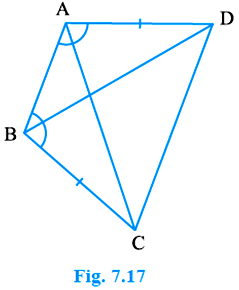
ABCD is a quadrilateral in which AD = BC and∠ DAB = ∠ CBA (see Fig. 7.17). Prove that

(i) Δ ABD ≅Δ BAC


(ii) BD = AC


(iii) ∠ ABD = ∠ BAC.


3

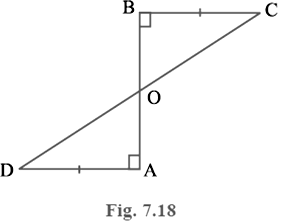
AD and BC are equal perpendiculars to a line segment AB (see Fig. 7.18). Show that CD bisects AB.

4

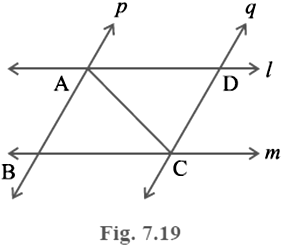
l and m are two parallel lines intersected by another pair of parallel lines p and q(see Fig. 7.19). Show that Δ ABC ≅Δ CDA.


5

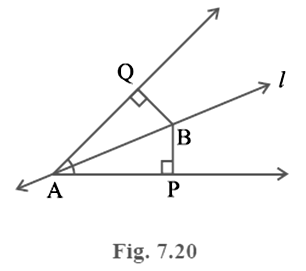
Line l is the bisector of an angle ∠ A and B is any point on l. BP and BQ are perpendiculars from B to the arms of ∠ A (see Fig. 7.20). Show that:

(i) Δ APB ≅Δ AQB


(ii) BP = BQ or B is equidistant from the arms of ∠ A.


Questions · 31
7. Triangles
1 2 3 4 5 6 7 8 1 2 3 4 5 6 7 8 1 2 3 4 5 1 2 3 4 5 6 1 2 3 4
Back to chapter
ADVERTISEMENT
About Contact Privacy Terms
Philoid · 2026
  • Home
  • Search
  • Browse
  • Quiz
  • Saved