Skip to content
Philoid
Browse Saved
Back to chapter
Mathematics
7. Triangles
Home · Class 9 · Mathematics · NCERT - Mathematics · 7. Triangles
Prev
Next
Q2 of 31 Page 128

AD is an altitude of an isosceles triangle ABC in which AB = AC. Show that

(i) AD bisects BC


(ii) AD bisects ∠ A

It is given in the question that:

AD is an altitude and AB = AC


(i) In


∠ADB = ∠ADC = 90o


AB = AC (Given)


AD = AD (Common)


Therefore,


By RHS axiom,


(By c.p.c.t)


(ii) ∠BAD = ∠CAD (By c.p.c.t)


Thus,


Ad bisects ∠A


More from this chapter

All 31 →
8

Show that the angles of an equilateral triangle are 60° each.

1

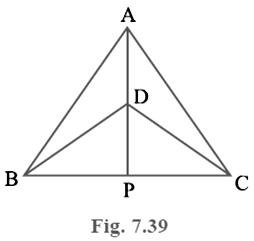
Δ ABC and Δ DBC are two isosceles triangles on the same base BC and vertices A and D are on the same side of BC (see Fig. 7.39). If AD is extended to intersect BC at P, show that

(i) Δ ABD ≅Δ ACD


(ii) Δ ABP ≅Δ ACP


(iii) AP bisects ∠ A as well as ∠ D.


(iv) AP is the perpendicular bisector of BC.


3

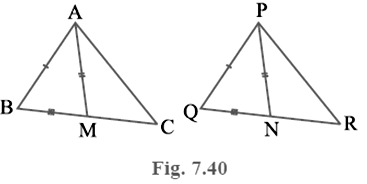
Two sides AB and BC and median AM of one triangle ABC are respectively equal to sides PQ and QR and median PN of Δ PQR (see Fig. 7.40). Show that:

(i) Δ ABM ≅Δ PQN


(ii) Δ ABC ≅Δ PQR


4

BE and CF are two equal altitudes of a triangle ABC. Using RHS congruence rule, prove that the triangle ABC is isosceles.

Questions · 31
7. Triangles
1 2 3 4 5 6 7 8 1 2 3 4 5 6 7 8 1 2 3 4 5 1 2 3 4 5 6 1 2 3 4
Back to chapter
ADVERTISEMENT
About Contact Privacy Terms
Philoid · 2026
  • Home
  • Search
  • Browse
  • Quiz
  • Saved