Q26 of 30 Page 11

Label the below given Figure 2.1 as directed below in (i) to (iv) and give the name of each type of teeth.


(i) The cutting and biting teeth as ‘A’


(ii) The piercing and tearing teeth as ‘B’


(iii) The grinding and chewing teeth as ‘C’


(iv)The grinding teeth present only in adult as ‘D’


(i) The cutting and biting teeth labelled as A are the incisors. They are the first teeth to develop in an infant. They are present in the front and are 8 in number.


(ii) The piercing and tearing teeth labelled as ‘B’ are the canines. They are 4 in number are present chiefly in the carnivorous animals.


(iii) The grinding and chewing teeth labelled as ‘C’ are the premolars. They are also 8 in number. They have a flat chewing surface.


(iv) The grinding teeth present only in adult labeled as ‘D’ are the molars. They are 12 in number and are present in adults.


More from this chapter

All 30 →
24

Boojho and Paheli were eating their food hurriedly so that they could go out and play during the recess. Suddenly, Boojho started coughing violently. Think of the reasons why he was coughing and discuss with your friends.

25

Fill in the blanks using the words listed below.

water, front, intestinal, salts, pseudopodia, back, vacuole


(a) The digestion of all food components is completed by the ____________ juice.


(b) Large intestine absorbs ___________ and some __________ from the undigested food.


(c) Tongue is attached at the _____________ to the floor of the mouth cavity and is free at the _____________.


(d) Amoeba pushes out _____________ around the food and traps it in a food _____________.

27

Read the following passage carefully and answer the questions that follows it. Bile juice is stored in a sac called, gall bladder, located near its organ of secretion, liver. The gall bladder releases the bile juice into the small intestine whenever food reaches there. Though bile juice is devoid of any digestive enzymes, it is required for the digestion of fats. The fats cannot be digested easily because they are insoluble in water and are present as large globules. Bile juice breaks down big fat droplets into smaller droplets. These are then easily digested by the enzymes released from the pancreas.

(a) Which organ secretes the bile juice?


(b) Why is digestion of fats difficult as compared to that of other nutrients?


(c) How does bile juice help in digestion of fat?


(d) Where is the digestion of fat completed?


(e) Does bile juice digest fat completely?

28

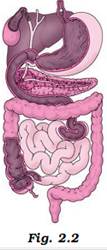
Label the following parts in Figure 2.2 and name them.


(a) The largest gland in our body.


(b) The organ where protein digestion starts.


(c) The organ that releases digestive juice into the small intestine.


(d) The organ where bile juice gets stored.