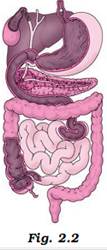
Read the following passage carefully and answer the questions that follows it. Bile juice is stored in a sac called, gall bladder, located near its organ of secretion, liver. The gall bladder releases the bile juice into the small intestine whenever food reaches there. Though bile juice is devoid of any digestive enzymes, it is required for the digestion of fats. The fats cannot be digested easily because they are insoluble in water and are present as large globules. Bile juice breaks down big fat droplets into smaller droplets. These are then easily digested by the enzymes released from the pancreas.
(a) Which organ secretes the bile juice?
(b) Why is digestion of fats difficult as compared to that of other nutrients?
(c) How does bile juice help in digestion of fat?
(d) Where is the digestion of fat completed?
(e) Does bile juice digest fat completely?
(a) Liver, the largest gland of the human body produces bile juice which gets stored in gall bladder and used when required.
(b) Digestion of fats is difficult because they are water insoluble and are present as large globules.
(c) Bile juice helps in emulsification of fats which means breakdown of larger fat molecules into smaller ones. This way bile juice helps in digestion of fat molecules.
(d) The digestion of fats get completed in small intestine. Fat emulsification is done by bile juice, which is secreted by liver, stored in gall bladder, and released in small intestine. As it is released in small intestine, fat emulsification gets completed in small intestine only.
(e) No, bile juice do not help in digestion of fat completely but it converts the bigger fat molecules into smaller droplets which makes it easier to get digested.
Couldn't generate an explanation.
Generated by AI. May contain inaccuracies — always verify with your textbook.