Skip to content
Philoid
Browse Saved
Back to chapter
Physics
8. Motion
Home · Class 9 · Physics · Ref. Book · 8. Motion
Prev
Next
Q14 of 53 Page 228

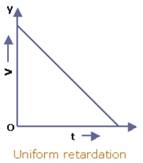
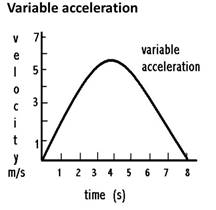
Plot velocity-time graph of a body.

(i) moving with a uniform retardation.


(ii) moving with a variable acceleration.

(i) moving with a uniform retardation

(ii) moving with a variable acceleration


More from this chapter

All 53 →
12

(i) If the velocity-time graph of an object is parallel to X-axis, then what does it mean? Can it be parallel to Y-axis?

(ii) What type of motion is represented by each one of the following graphs?


(iii) A bus increases its speed from 36 km/h to 54 km/h in 10 s. Find its acceleration.

13

Study the velocity-time graph and calculate.


(i) the acceleration from A to B.


(ii) the acceleration from B to C.


(iii) the distance covered in the region ABE.


(iv) the average velocity from C to D.


(v) the distance covered in the region BCFE.

15

A body starts to slide over a horizontal surface with an initial velocity of 0.5 m/s. Due to friction, its velocity decreases at the rate 0.105 m/s2. How much time will it take for the body to stop?

16

Look at the figure below and answer the following questions:


(i) Name the kind of motion of the stone.


(ii) It this an example of accelerated motion? Why?


(iii)Name the force that keeps the stone in its path.


(iv) What is the direction of this force? Draw it in your answer sheet.

Questions · 53
8. Motion
1 2 3 4 5 1 2 3 4 5 1 2 3 4 5 6 1 2 3 4 5 1 2 3 4 5 6 7 8 9 10 11 12 13 14 15 16 17 18 19 20 21 22 23 1 2 3 4 5 6 7 8 9
Back to chapter
ADVERTISEMENT
About Contact Privacy Terms
Philoid · 2026
  • Home
  • Search
  • Browse
  • Quiz
  • Saved