
If one angle of a parallelogram is 36° less than the twice its adjacent angles, then find the angles of the parallelogram.
Sum of adjacent angles of parallelogram = 180°
Given:
One angle of Parallelogram = 2 (adjacent angle) – 36°
Let the angle of parallelogram be x

Sum of adjacent angles of parallelogram = 180°
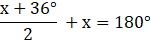
2x +x + 36° = 180°
3x = 180° – 36°
3x = 144°

x = 48°
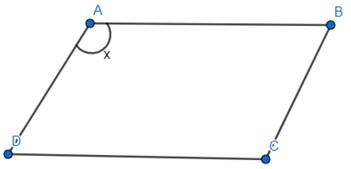
Now from the diagram, we know that,
∠A = 48°
∠B = 180° – 48° = 132°
∠C = ∠A = 48°
∠D = ∠B = 132°
AI is thinking…
Couldn't generate an explanation.
Generated by AI. May contain inaccuracies — always verify with your textbook.
