Q29 of 41 Page 1

(i) Define corrosion. Under what conditions does corrosion take place?

(ii) Give the formula and the chemical name of rust.

(i) Corrosion is a natural process of wasting of metal due to reaction of the metals with environmental factors like moisture, oxygen etc to form corresponding metallic compounds. The metal undergoing corrosion losses its strength, appearance and its efficiency.

Corrosion generally takes place under following conditions:


1. Exposure of metals to humid climatic conditions for a long period of time


2. Exposure of metals to reactive gases and liquids for long period of time.


3. Environmental condition of the place where metal is placed like temperature of the surrounding, moisture content in the air, etc.


(ii) The chemical formula for rust is Fe2O3.nH2O(s).


Where n is the water of crystallization.


The rust is formed by the following equation:


The iron hydroxide formed dehydrates to produce Fe2O3.nH2O(s).

More from this chapter

All 41 →
27

Zinc oxide reacts with carbon, on heating to form zinc metal and carbon monoxide. Write a balanced chemical equation for this reaction. Name

(i) Oxidising agent


(ii) The reducing agent in this reaction.

28

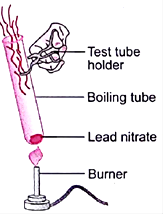
Observe the diagram given alongside and answer the following questions:


a. What do you observe when lead nitrate is heated?


b. Mention the two gases evolved equation for it.


c. Write the balanced chemical equation for it.


d. What is the type of chemical reaction called?


e. Give one more example of this type of reaction.

30

Write balanced chemical equations for the following word equations:

(a) Calcium hydroxide + Carbon dioxide Calcium carbonate + Water


(b) Phosphorus pentachloride + Water Phosphoric acid + Hydrogen chloride


(c) Zinc + Silver nitrate Zinc nitrate + Silver


(d) Sodium + water sodium hydroxide + Hydrogen


(e) Aluminium + Copper chloride Aluminium chloride + Copper

31

Identify the type of chemical reaction taking place in each of the following:

(a) Barium chloride solution is mixed with a copper sulphate solution and a white precipitate is observed.


(b) On heating copper powder in the air in a china dish, the surface of copper powder turns black.


(c) On heating, green coloured ferrous sulphate crystals, reddish brown solid is left and a smell of a gas having an odour of burning sulphate is experienced.


(d) Iron nails when left dipped in blue copper sulphate solution become brownish in colour and the blue colour of copper sulphate fades away.


(e) Quick lime reacts vigorously with water releasing a large amount of heat.