
If x = a (θ – sin θ), y = a (1 + cos θ) find  . (CBSE 2011)
Idea of parametric form of differentiation:
If y = f (θ) and x = g(θ) i.e. y is a function of θ and x is also some other function of θ.
Then dy/dθ = f’(θ) and dx/dθ = g’(θ)
We can write : 
Given,
x = a (θ – sin θ) ……equation 1
y = a (1+ cos θ) ……equation 2
to find : 
As, 
So, lets first find dy/dx using parametric form and differentiate it again.
 …..equation 3
Similarly,
 ……equation 4
[∵ 
 …..equation 5
Differentiating again w.r.t x :
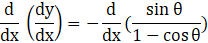
Using product rule and chain rule of differentiation together:

Apply chain rule to determine 
 [using equation 3]


 [ ∵
[ ∵  ]
]

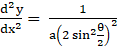 [ ∵1– cos θ = 2sin2 θ/2]
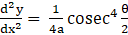
∴ 
Couldn't generate an explanation.
Generated by AI. May contain inaccuracies — always verify with your textbook.

 (CBSE 2011)
 (CBSE 2011)
 (CBSE 2012)