
Using vectors, find the area of the triangle with vertices
A(1, 2, 3), B(2, –1, 4) and C(4, 5, –1)[CBSE 2017]
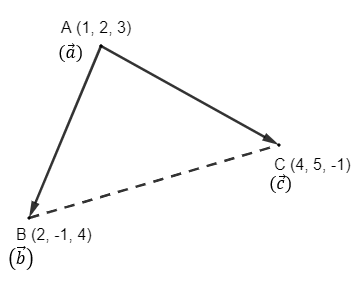
Given three points A(1, 2, 3), B(2, –1, 4) and C(4, 5, –1) forming a triangle.
Let position vectors of the vertices A, B and C of ΔABC be ,
,  and
and  respectively.
We know position vector of a point (x, y, z) is given by , where
 ,
,  and
and  are unit vectors along X, Y and Z directions.


Similarly, we have and
and
To find area of ΔABC, we need to find at least two sides of the triangle. So, we will find vectors and
and .
.
Recall the vector  is given by

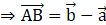



Similarly, the vector  is given by

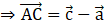



Recall the area of the triangle whose adjacent sides are given by the two vectors  and
and  is
is  where
where

Here, we have (a1, a2, a3) = (1, –3, 1) and (b1, b2, b3) = (3, 3, –4)




Recall the magnitude of the vector  is
is

Now, we find .
.



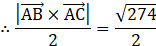
Thus, area of the triangle is  square units.
Couldn't generate an explanation.
Generated by AI. May contain inaccuracies — always verify with your textbook.


 [CBSE 2018]