Solution of Chapter 7. Alternating Current (Physics - Exemplar Book)
Chapter Exercises
MCQ I
If the rms current in a 50 Hz ac circuit is 5 A, the value of the current 1/300 seconds after its value becomes zero is
view answer >An alternating current generator has an internal resistance Rg and an internal reactance Xg. It is used to supply power to a passive load consisting of a resistance Rg and a reactance XL. For maximum power to be delivered from the generator to the load, the value of XL is equal to
view answer >When a voltage measuring device is connected to AC mains, the meter shows the steady input voltage of 220V. This means
view answer >To reduce the resonant frequency in an LCR series circuit with a generator
view answer >Which of the following combinations should be selected for better tuning of an LCR circuit used for communication?
view answer >An inductor of reactance 1Ω and a resistor of 2 Ω are connected in series to the terminals of a 6 V (rms) a.c. source. The power dissipated in the circuit is
view answer >The output of a step-down transformer is measured to be 24 V when connected to a 12-watt light bulb. The value of the peak current is
view answer >MCQ II
As the frequency of an ac circuit increases, the current first increases and then decreases. What combination of circuit elements is most likely to comprise the circuit?
view answer >In an alternating current circuit consisting of elements in series, the current increases on increasing the frequency of supply. Which of the following elements are likely to constitute the circuit?
view answer >Electrical energy is transmitted over large distances at high alternating voltages. Which of the following statements is (are) correct?
view answer >For an LCR circuit, the power transferred from the driving source to the driven oscillator is P = I2Z cosϕ
view answer >When an AC voltage of 220 V is applied to the capacitor C
view answer >The line that draws power supply to your house from street has
view answer >VSA
If a LC circuit is considered analogous to a harmonically oscillating spring block system, which energy of the LC circuit would be analogous to potential energy and which one analogous to kinetic energy?
view answer >Draw the effective equivalent circuit of the circuit shown in Fig 7.1, at very high frequencies and find the effective impedance.

view answer >
Study the circuits (a) and (b) shown in Fig 7.2 and answer the following questions.
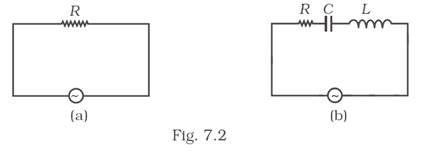
(a) Under which conditions would the rms currents in the two circuits be the same?
(b) Can the rms current in circuit (b) be larger than that in (a)?
view answer >
Can the instantaneous power output of an ac source ever be negative? Can the average power output be negative?
view answer >In series LCR circuit, the plot of Imax vs ω is shown in Fig 7.3. Find the bandwidth and mark in the figure.

view answer >
The alternating current in a circuit is described by the graph shown in Fig 7.4. Show rms current in this graph.

view answer >
How does the sign of the phase angle ϕ, by which the supply voltage leads the current in an LCR series circuit, change as the supply frequency is gradually increased from very low to very high values.
view answer >SA
A device ‘X’ is connected to an a .c source. The variation of voltage, current and power in one complete cycle is shown in Fig 7.5.

(a) Which curve shows power consumption over a full cycle?
(b) What is the average power consumption over a cycle?
(c) Identify the device ‘X’.
view answer >
Both alternating current and direct current are measured in amperes. But how is the ampere defined for an alternating current?
A coil of 0.01 henry inductance and 1-ohm resistance is connected to 200 volts, 50 Hz ac supply. Find the impedance of the circuit and time lag between max. alternating voltage and current.
A 60 W load is connected to the secondary of a transformer whose primary draws line voltage. If a current of 0.54 A flows in the load, what is the current in the primary coil? Comment on the type of transformer being used.
Explain why the reactance provided by a capacitor to an alternating current decreases with increasing frequency.
Explain why the reactance offered by an inductor increases with increasing frequency of an alternating voltage.
LA
An electrical device draws 2kW power from AC mains  The current differs (lags) in phase by
  as compared to voltage. Find (i) R, (ii) XC – XL, and (iii) IM. Another device has twice the values for R, XC and XL. How are the answers affected?
1MW power is to be delivered from a power station to a town 10 km away. One uses a pair of Cu wires of radius 0.5 cm for this purpose. Calculate the fraction of ohmic losses to power transmitted if
(i) power is transmitted at 220V. Comment on the feasibility of doing this.
(ii) a step-up transformer is used to boost the voltage to 11000 V, power transmitted, then a step-down transformer is used to bring voltage to 220 V.
(ρcu = 1.7 × 10⁻⁸ SI unit)
view answer >
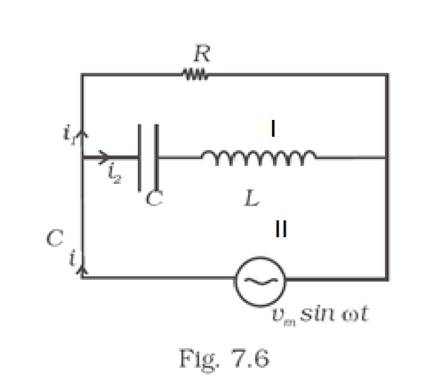
Consider the LCR circuit shown in Fig 7.6. Find the net current i and the phase of i. Show that  . Find the impedance Z for this circuit.
view answer >
For an LCR circuit driven at frequency ω, the equation reads

(i) Multiply the equation by i and simplify where possible.
(ii) Interpret each term physically.
(iii) Cast the equation in the form of a conservation of energy statement.
(iv) Integrate the equation over one cycle to find that the phase difference between v and i must be acute.
view answer >
In the LCR circuit shown in Fig 7.7, the ac driving voltage is 

(i) Write down the equation of motion for q (t).
(ii) At t = t0, the voltage source stops and R is short circuited. Now write down how much energy is stored in each of L and C.
(iii) Describe subsequent motion of charges.
view answer >