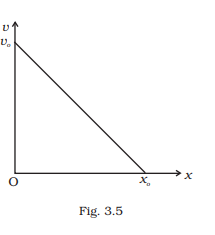
It is a common observation that rain clouds can be at about a kilometre altitude above the ground.
(a) If a rain drop falls from such a height freely under gravity, what will be its speed? Also calculate in km/h. (g = 10m/s2)
(b) A typical rain drop is about 4mm diameter. Momentum is mass x speed in magnitude. Estimate its momentum when it hits ground.
(c) Estimate the time required to flatten the drop.
(d) Rate of change of momentum is force. Estimate how much force such a drop would exert on you.
(e) Estimate the order of magnitude force on umbrella. Typical lateral separation between two rain drops is 5 cm. (Assume that umbrella is circular and has a diameter of 1m and cloth is not pierced through !!)
Height = 1km = 1000m
Initial Speed = 0 (freely falling under gravity)
Acceleration (a) = g (freely falling under gravity)
Let final speed be v m/s
Using equation of motion, we have


(b) Diameter of the rain drop (d) = 4 mm = 4 x 10⁻³ m
Volume of the rain drop (considering it to be spherical) = 
Mass of the rain drop = density of water x volume of drop = 
Mass = 3.349 x 10⁻⁵ kg
Momentum of the drop = Mass x velocity = 3.349 x 10-5 x 140 = 4.68 x 10⁻³ kg-m/s
(c) Time required to flatten the drop will be same as the time it takes to cover a distance equal to its diameter close to the ground.

(d) Force exerted = Change of momentum/time

(e) Radius of the umbrella = � m = 0.5 m
Area of the umbrella = 
Lateral separation between rain drops = 5 cm = 5 x 10⁻² m
Number of rain drops falling on the umbrella = 
Total force exerted = (314 x 168) = 52752 N
Couldn't generate an explanation.
Generated by AI. May contain inaccuracies — always verify with your textbook.