Q24 of 26 Page 18

A motor car moving at a speed of 72km/h cannot come to a stop in less than 3.0 s while for a truck this time interval is 5.0 s. On a highway the car is behind the truck both moving at 72km/h. The truck gives a signal that it is going to stop at emergency. At what distance the car should be from the truck so that it does not bump onto (collide with) the truck. Human response time is 0.5s.

(Comment : This is to illustrate why vehicles carry the message on the rear side. “Keep safe Distance”)


Time required by the truck to reach 0 km/h (t1) = 5s

Initial speed of the truck (u) = 72 km/h = 20 m/s


Final speed (v) = 0 m/s


Deceleration of the truck ( �atruck) can be calculated using equations of motion.


(Negative sign denotes deceleration/retardation)


For the car, time required to stop = 3s


We can find the deceleration of the car similarly to how we found of the truck above.


The human response time is 0.5s. This means after the truck gives signal, the car will begin to retard after 0.5 seconds. For these 0.5 seconds, the car will move at a uniform speed.


Let the car be at a distance ‘x’ when the truck gives the signal and ‘t’ be the time taken to cover this distance.


Velocity of car (v,) after time t will be


Velocity of truck after time t (v,,)


For avoiding the car to bump into the truck


On solving for t, we get


Distance travelled by the truck in t = 1.25 seconds (s1)


Distance travelled by the car in time t is the sum of the distance travelled by the car with uniform velocity for 0.5 seconds and the distance travelled by the car while retarding for (t – 0.5) seconds (s2)


Safe distance = s2 – s1 = (23.125 – 21.875) m = 1.25 m


More from this chapter

All 26 →
22

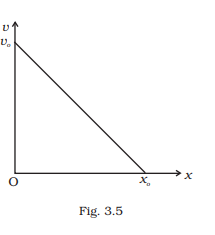
The velocity-displacement graph of a particle is shown in Fig. 3.5.

(a) Write the relation between v and x.


(b) Obtain the relation between acceleration and displacement and plot it.


23

It is a common observation that rain clouds can be at about a kilometre altitude above the ground.

(a) If a rain drop falls from such a height freely under gravity, what will be its speed? Also calculate in km/h. (g = 10m/s2)


(b) A typical rain drop is about 4mm diameter. Momentum is mass x speed in magnitude. Estimate its momentum when it hits ground.


(c) Estimate the time required to flatten the drop.


(d) Rate of change of momentum is force. Estimate how much force such a drop would exert on you.


(e) Estimate the order of magnitude force on umbrella. Typical lateral separation between two rain drops is 5 cm. (Assume that umbrella is circular and has a diameter of 1m and cloth is not pierced through !!)


25

A monkey climbs up a slippery pole for 3 seconds and subsequently slips for 3 seconds. Its velocity at time t is given by v(t) = 2t (3-t); 0< t < 3 and v (t)=–(t–3)(6–t) for 3 < t < 6 s in m/s. It repeats this cycle till it reaches the height of 20 m.

(a) At what time is its velocity maximum?


(b) At what time is its average velocity maximum?


(c) At what time is its acceleration maximum in magnitude?


(d) How many cycles (counting fractions) are required to reach the top?


26

A man is standing on top of a building 100 m high. He throws two balls vertically, one at t = 0 and other after a time interval (less than 2 seconds). The later ball is thrown at a velocity of half the first. The vertical gap between first and second ball is +15 m at t = 2 s. The gap is found to remain constant. Calculate the velocity with which the balls were thrown and the exact time interval between their throw.