Q41 of 94 Page 442

A vessel of volume 125 cm3 contains tritium (3H, t1/2 = 12.3 y) at 500 kPa and 300 K. Calculate the activity of the gas.

Given: Pressure P= 500000 Pa= 5 atm


Volume V= 0.125L


Temperature T= 300K


Assuming the gas to be ideal, according to ideal gas equation,


(R be universal gas constant equal to 0.082atmLmol-1K-1, P is the pressure, V is the volume, T is the temperature)


So,


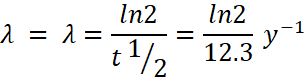
Activity,


More from this chapter

All 94 →
39

Consider the situation of the previous problem. Suppose the production of the radioactive isotope starts at t = 0. Find the number of active nuclei at time t.

40

In an agricultural experiment, a solution containing 1 mole of a radioactive material (t1/2 = 14.3 days) was injected into the roots of a plant. The plant was allowed 70 hours to settle down and then activity was measured in its fruit. If the activity measured was 1 μCi, what per cent of activity is transmitted from the root to the fruit in steady state?

42

can disintegrate either by emitting an α-particle or by emitting a β-particle.

(a) Write the two equations showing the products of the decays.


(b) The probabilities of disintegration by α-and β-decays are in the ratio 7/13. The overall half-life of 212Bi is one hour. If 1g of pure 212Bi is taken at 12.00 noon, what will be the composition of this sample at 1 p.m. the same day?


43

A sample contains a mixture of 110Ag and 108Ag isotopes each having an activity of 8.0 × 10⁸ disintegrations per second. 108Ag is known to have larger half-life than 110Ag. The activity A is measured as a function of time and the following data are obtained.

(a) Plot ln(A/A0) versus time.


(b) See that for large values of time, the plot is nearly linear. Deduce the half-life of 108Ag from this portion of the plot.


(c) Use the half-life of 108Ag to calculate the activity corresponding to 110Ag in the first 50 s.


(d) Plot ln(A/A0) versus time for 110Ag for the first 50 s.


(e) Find the half-life of 108Ag.