Q44 of 94 Page 442

A human body excretes (removes by waste discharge, sweating, etc.) certain materials by a law similar to radioactivity. If technetium is injected in some form in a human body, the body excretes half the amount in 24 hours. A patient is given an injection containing 99Tc. This isotope is radioactive with a half-life of 6 hours. The activity from the body just after the injection is 6 μCi. How much time will elapse before the activity falls to 3 μCi?

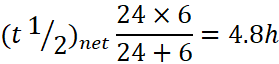
Given, t1=24h and t2=6h.

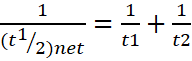
As both reactions are occurring parallel,


So,


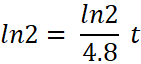
A˳= 6 μCi and A=3 μCi


More from this chapter

All 94 →
42

can disintegrate either by emitting an α-particle or by emitting a β-particle.

(a) Write the two equations showing the products of the decays.


(b) The probabilities of disintegration by α-and β-decays are in the ratio 7/13. The overall half-life of 212Bi is one hour. If 1g of pure 212Bi is taken at 12.00 noon, what will be the composition of this sample at 1 p.m. the same day?


43

A sample contains a mixture of 110Ag and 108Ag isotopes each having an activity of 8.0 × 10⁸ disintegrations per second. 108Ag is known to have larger half-life than 110Ag. The activity A is measured as a function of time and the following data are obtained.

(a) Plot ln(A/A0) versus time.


(b) See that for large values of time, the plot is nearly linear. Deduce the half-life of 108Ag from this portion of the plot.


(c) Use the half-life of 108Ag to calculate the activity corresponding to 110Ag in the first 50 s.


(d) Plot ln(A/A0) versus time for 110Ag for the first 50 s.


(e) Find the half-life of 108Ag.


45

A charged capacitor of capacitance C is discharged through a resistance R. A radioactive sample decays with an average-life τ. Find the value of R for which the ratio of the electrostatic field energy stored in the capacitor to the activity of the radioactive sample remains constant in time.

46

Radioactive isotopes are produced in a nuclear physics experiment at a constant rate dN/dt = R. An inductor of inductance 100 mH, a resistor of resistance 100 Ω and a battery are connected to form a series circuit. The circuit is switched on at the instant the production of radioactive isotope starts. It is found that i/N remains constant in time where i is the current in the circuit at time t and N is the number of active nuclei at time t. Find the half-life of the isotope.