Skip to content
Philoid
Browse Saved
Back to chapter
Physics
43. Bohr’s Model and Physics of the Atom
Home · Class 12 · Physics · Ref. Book · 43. Bohr’s Model and Physics of the Atom
Prev
Next
Q2 of 106 Page 384

Find the wavelength of the radiation emitted by hydrogen in the transitions A. n=3 to n=2, B. n=5 to n=4 and

C. n=10 to n=9.


We know that the wavelength is given by,
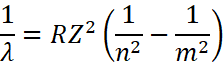


As the atom is hydrogen atom, so Z=1.


A. Here, n=2 and m=3.Thus,
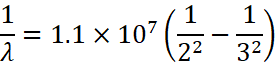


B. Here, n=4, m=5.Thus,



C. Here, n=9, m=10. Thus,



More from this chapter

All 106 →
53

Calculate the energy that can be obtained from 1 kg of water through the fusion reaction

2H + 2H →3H + p.


Assume that 1.5 × 10⁻²% of natural water is heavy water D2O (by number of molecules) and all the deuterium is used for fusion.


1

The Bohr radius is given by, .Verify that the RHS has dimensions of length.

3

Calculate the smallest wavelength of radiation that may be emitted by A. hydrogen B. and C.

4

Evaluate Rydberg constant by putting the values of the fundamental constants in its expression.

Questions · 106
43. Bohr’s Model and Physics of the Atom
2 3 12 1 2 3 4 5 6 7 8 9 10 3 5 8 9 10 12 13 15 19 1 2 3 4 5 6 7 8 9 10 11 12 13 5 6 8 9 10 1 2 3 4 5 6 3 5 7 10 14 15 16 21 26 29 35 41 50 53 1 2 3 4 5 6 7 8 9 10 11 12 13 14 15 16 17 18 19 20 21 22 23 24 25 26 27 28 29 30 31 32 33 34 35 36 37 38 39 40 41 42 43 44 45 46
Back to chapter
ADVERTISEMENT
About Contact Privacy Terms
Philoid · 2026
  • Home
  • Search
  • Browse
  • Quiz
  • Saved