Skip to content
Philoid
Browse Saved
Back to chapter
Physics
43. Bohr’s Model and Physics of the Atom
Home · Class 12 · Physics · Ref. Book · 43. Bohr’s Model and Physics of the Atom
Prev
Next
Q25 of 106 Page 384

Calculate the magnetic dipole moment corresponding to the motion of the electron in the ground state of a hydrogen atom.

We know that dipole moment


As hydrogen atom is in ground state, so


And we know that


Adding both the equations we get


Hence,


Now from Bohr’s model
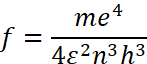


And area is equal to


So,



More from this chapter

All 106 →
23

Find the temperature at which the average thermal kinetic energy is equal to the energy needed to take a hydrogen atom from its ground state to n = 3 state. Hydrogen can now emit red light of wavelength 653.1 nm. Because of Maximillian distribution of speeds, a hydrogen sample emits red light at temperatures much lower than that obtained from this problem. Assume that hydrogen molecules dissociate into atoms.

24

Average lifetime of a hydrogen atom excited to n = 2 state is 10–8 s. Find the number of revolutions made by the electron on the average before it jumps to the ground state.

26

Show that the ratio of the magnetic dipole moment to the angular momentum (ℓ = mvr) is a universal constant for hydrogen like atoms and ions. Find its value.

27

A beam of light having wavelengths distributed uniformly between 450 nm to 550 nm passes through a sample of hydrogen gas. Which wavelength will have the least intensity in the transmitted beam?

Questions · 106
43. Bohr’s Model and Physics of the Atom
2 3 12 1 2 3 4 5 6 7 8 9 10 3 5 8 9 10 12 13 15 19 1 2 3 4 5 6 7 8 9 10 11 12 13 5 6 8 9 10 1 2 3 4 5 6 3 5 7 10 14 15 16 21 26 29 35 41 50 53 1 2 3 4 5 6 7 8 9 10 11 12 13 14 15 16 17 18 19 20 21 22 23 24 25 26 27 28 29 30 31 32 33 34 35 36 37 38 39 40 41 42 43 44 45 46
Back to chapter
ADVERTISEMENT
About Contact Privacy Terms
Philoid · 2026
  • Home
  • Search
  • Browse
  • Quiz
  • Saved
