Skip to content
Philoid
Browse Saved
Back to chapter
Physics
5. Newton’s Laws of Motion
Home · Class 11 · Physics · Ref. Book · 5. Newton’s Laws of Motion
Prev
Next
Q7 of 82 Page 79

Two blocks A and B of mass mA and m9 respectively are kept in contact on a frictionless table. The experimenter pushes the block A from behind so that the blocks accelerate. If the block A exerts a force F on the block B, what is the force exerted by the experimenter on A?

Let be the force by the experimenter.


From the FBD of block A,
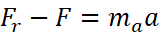

---(1)


From the FBD of block A,


---(2)


∴ equation (1) becomes,


Equating acceleration from both the equations, we get


Thus, answer is,


More from this chapter

All 82 →
5

Two blocks of equal mass m are tied to each other through a light string. One of the blocks is pulled along the line joining them with a constant force F. Find the tension in the string joining the blocks.

6

A particle of mass 50 g moves on a straight line. The variation of speed with time is shown in figure (5-E1). Find the force acting on the particle at t =2, 4 and 6 seconds.


8

Raindrops of radius 1 mm and mass 4 mg are falling with a speed of 30 m/s on the head of a bald person. The drops splash on the head and come to rest. Assuming equivalently that the drops cover a distance equal to their radii on the head, estimate the force exerted by each drop on the head.

9

A particle of mass 0.3 kg is subjected to a force F = - k x with k = 15 N/m. What will be its initial acceleration if it is released from a point x = 20 cm?

Questions · 82
5. Newton’s Laws of Motion
1 2 3 4 5 6 7 8 9 10 11 12 13 14 15 16 17 1 2 3 4 5 6 7 8 9 10 11 12 13 14 1 2 3 4 5 6 7 8 9 1 2 3 4 5 6 7 8 9 10 11 12 13 14 15 16 17 18 19 20 21 22 23 24 25 26 27 28 29 30 31 32 33 34 35 36 37 38 39 40 41 42
Back to chapter
ADVERTISEMENT
About Contact Privacy Terms
Philoid · 2026
  • Home
  • Search
  • Browse
  • Quiz
  • Saved