Skip to content
Philoid
Browse Saved
Back to chapter
Physics
5. Newton’s Laws of Motion
Home · Class 11 · Physics · Ref. Book · 5. Newton’s Laws of Motion
Prev
Next
Q29 of 82 Page 79

In the previous problem, suppose m2 = 2.0 kg and m3 = 3.0 kg. What should be the mass m so that it remains at rest?
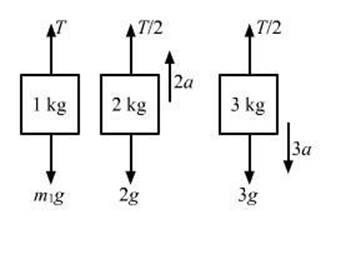


Given: m1= 1kg, m2= 2kg, m3=3kg


For m1 to be at rest, a1 = 0.


T − m1 g = 0


T = m 1g …(i)


For mass m2, − 2g = 2a


T = 4a + 4g …(ii)


For mass m3, 3g – = 2a


T = 6g − 6a


From equations (ii) and (iii), we get:


3T – 12g = 12g – 2T


T = = 4.08g


Substitute the value of T in equation (i), we get: m1 = 4.8kg


More from this chapter

All 82 →
27

In figure (5-E11) m1 = 5 kg, m2 = kg and F = 1 N. Find the acceleration of either block. Describe the motion of m if the string breaks but F continues to act.

28

Let m1 = 1 kg, m2 = 2 kg and m3 = 3 kg in figure (5-E12). Find the accelerations of m1, m2 and m3. The string from the upper pulley to m1 is 20 cm when the system is released from rest. How long will it take before m1 strikes the pulley?


30

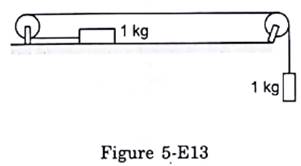
Calculate the tension in the string shown in figure (5-E13). The pulley and the string are light and all surfaces are frictionless. Take g = 10 m/s2.


31

Consider the situation shown in figure (5-E14). Both the pulleys and the string are light and all the surfaces are frictionless. (a) Find the acceleration of the mass M. (b) Find the tension in the string. (c) Calculate the force exerted by the clamp on the pulley A in the figure.


Questions · 82
5. Newton’s Laws of Motion
1 2 3 4 5 6 7 8 9 10 11 12 13 14 15 16 17 1 2 3 4 5 6 7 8 9 10 11 12 13 14 1 2 3 4 5 6 7 8 9 1 2 3 4 5 6 7 8 9 10 11 12 13 14 15 16 17 18 19 20 21 22 23 24 25 26 27 28 29 30 31 32 33 34 35 36 37 38 39 40 41 42
Back to chapter
ADVERTISEMENT
About Contact Privacy Terms
Philoid · 2026
  • Home
  • Search
  • Browse
  • Quiz
  • Saved