Skip to content
Philoid
Browse Saved
Back to chapter
Physics
11. Gravitation
Home · Class 11 · Physics · Ref. Book · 11. Gravitation
Prev
Next
Q10 of 81 Page 224

The time period of an earth-satellite in circular orbit is independent of

The time period of a satellite in a circular orbit is given by,
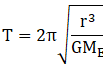

where, is the radius of the orbit of the satellite. G is the gravitational constant, is the mass of the earth. Hence, it depends on the radius while its independent of the mass of the satellite.

More from this chapter

All 81 →
8

Let V and E represent the gravitational potential and field at a distance r from the Centre of a uniform solid sphere. Consider the two statements:

(A)The plot of V against r is discontinuous


(B)The plot of E against r is discontinuous


19

Take the effect of bulging of earth and its rotation in account. Consider the following statement:

(A)There are points outside the earth where the value of g is equal to its value at the equator.


(B)There are points outside the earth where the value of g is equal to its value at the poles.


11

The magnitude of gravitational potential energy of the moon-earth system is U with zero potential energy at infinite separation. The kinetic energy of the moon with respect to the earth is K.

12

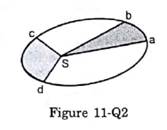
Figure (11-Q2) shows the elliptical path of a planet about the sun. The two shaded parts have equal area. If t1 and t2 be the time taken by the planet to go from a to b and from c to d respectively.


Questions · 81
11. Gravitation
1 2 3 4 5 6 7 8 9 10 11 12 13 14 15 16 17 18 19 1 2 3 4 5 6 7 8 19 10 11 12 13 14 15 16 17 1 2 3 4 5 6 1 2 3 4 5 6 7 8 9 10 11 12 13 14 15 16 17 18 19 20 21 22 23 24 25 26 27 28 29 30 31 32 33 34 35 36 37 38 39
Back to chapter
ADVERTISEMENT
About Contact Privacy Terms
Philoid · 2026
  • Home
  • Search
  • Browse
  • Quiz
  • Saved