Q2 of 30 Page 40

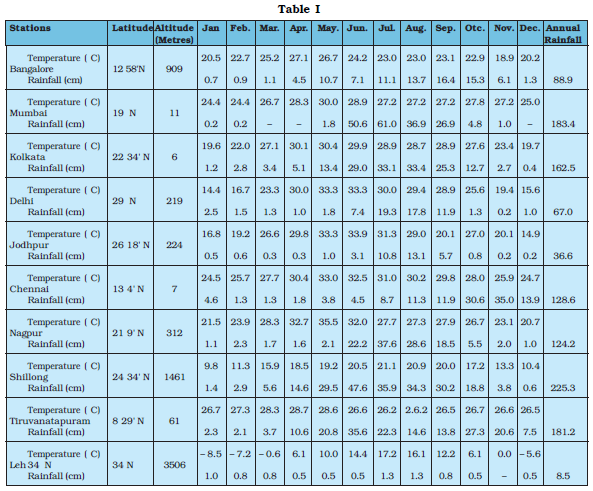
Re-arrange the ten stations in two different sequences:

(i) According to their distance from the equator.


(ii) According to their altitude above mean sea-level.


(i)


Stations


Distance from the equator


1. Thiruvanantapuram


2. Bengaluru


3. Chennai


4. Mumbai


5. Nagpur


6. Kolkata


7. Shillong


8. Jodhpur


9. Delhi


10. Leh


8°29’ Ν


12°58′ Ν


13°4 Ν


19° N


21°9 N


22°34'N


24°34'N


26°18' N


29° N


34° N


(ii)


Stations


Altitude about mean sea-level


1. Kolkata


2. Bengaluru


3. chennai


4. Mumbai


5. Nagpur


6. Kolkata


7. Shillong


8. Jodhpur


9. Dlhi


10. Leh


6 metre


7metre


11 metre


61 metre


219 metre


224 metre


312 metre


909 metre


1461 metre


3506 metre


More from this chapter

All 30 →
1

Collect photographs of typical rural houses, and clothing of people from different regions of India. Examine whether they reflect any relationship with the climatic condition and relief of the area.

1

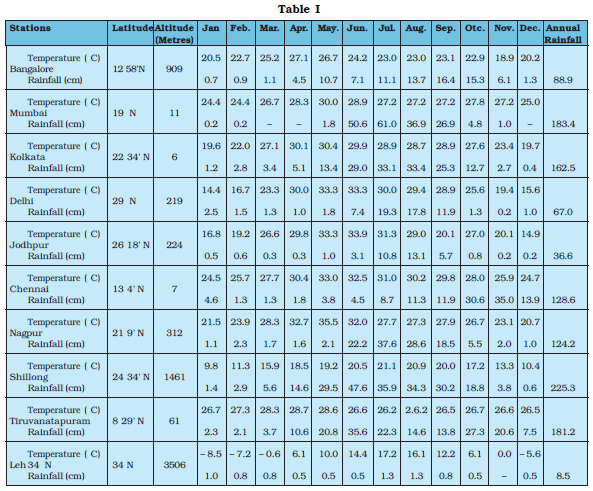
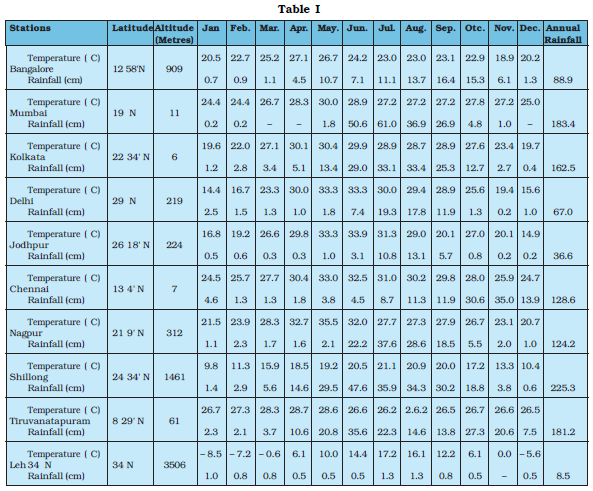
In Table-I the average mean monthly temperatures and amounts of rainfall of ten representative stations have been given. It is for you to study on your own and convert them into ‘temperature and rainfall' graphs. A glance at these visual representations will help you to grasp instantly the similarities and differences between them. One such graph (Figure attached) is already prepared for you. See if you can arrive at some broad generalizations’ about our diverse climatic conditions. We hope you are in for a great joy of learning. Do the following activities.

3

(i) Name two rainiest stations.

(ii) Name two driest stations.


(iii) Two stations with most equable climate.


(iv) Two stations with most extreme climate.


(v) Two stations most influenced by the Arabian branch of southwest monsoons.


(vi) Two stations most influenced by the Bay of Bengal branch of south-west monsoons.


(vii) Two stations influenced by both branches of the south-west monsoons.


(viii) Two stations influenced by retreating and north-east monsoons.


(ix) Two stations receiving winter showers from the western disturbances.


(x) The two hottest stations in the month of (a) February, (b) April, (c) May, (d) June.


4

Now find out


(i) Why are Thiruvananthapuram and Shillong rainier in June than in July?


(ii) Why is July rainier in Mumbai than in Thiruvananthapuram?


(iii) Why are southwest monsoons lessrainy in Chennai?


(iv) Why is Shillong rainier than Kolkata?


(v) Why is Kolkata rainier in July than in June unlike Shillong which is rainier in June than in July 2


(vi) Why does Delhi receive more rain than Jodhpur?