Now find out

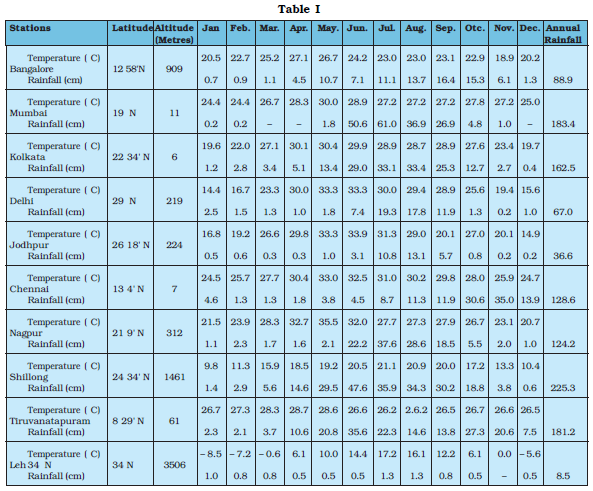
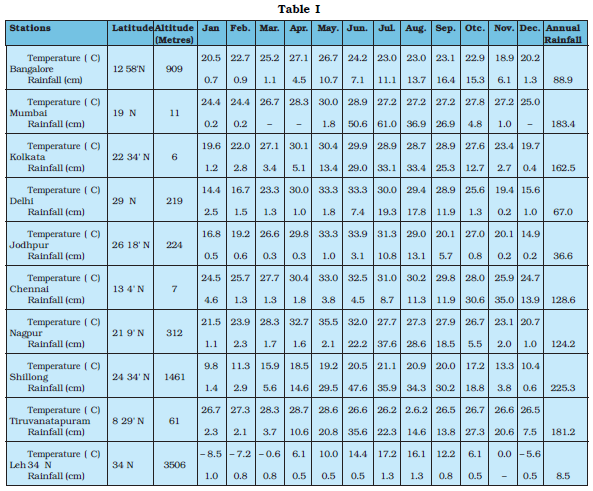
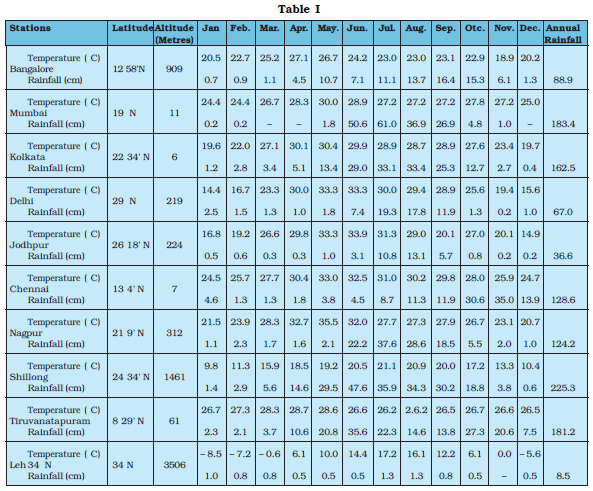
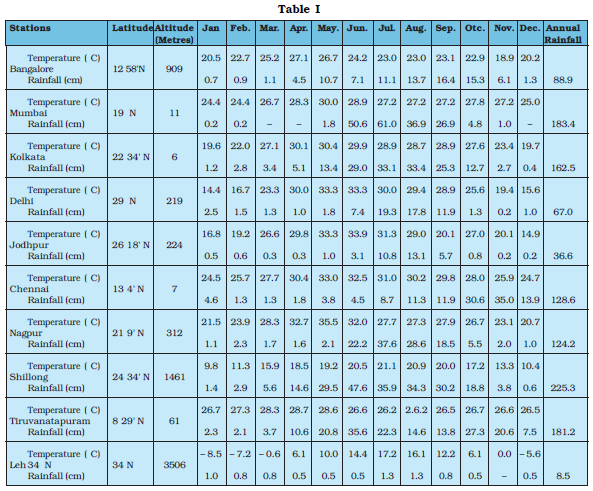
(i) Why are Thiruvananthapuram and Shillong rainier in June than in July?
(ii) Why is July rainier in Mumbai than in Thiruvananthapuram?
(iii) Why are southwest monsoons lessrainy in Chennai?
(iv) Why is Shillong rainier than Kolkata?
(v) Why is Kolkata rainier in July than in June unlike Shillong which is rainier in June than in July 2
(vi) Why does Delhi receive more rain than Jodhpur?
(i) Thiruvananthapuram receives the rainfall caused by South West monsoon winds instantly as it is located on proximity to Indian Ocean. Monsoon winds enter here on 1st June every year and it receives heavy rains. Shillong receives rainfall by virtue of the Bay of Bengal branch of the S.W. monsoon. As monsoon winds change their course in July, it receives less rain in that month.
(ii) Mumbai falls in proximity to the Arabian Sea and monsoon winds starts blowing here in the second week of June. The monsoon takes time to reach to the places that are away from the coastal areas. In the subsequent weeks of June, the monsoon reaches to Thiruvananthapuram and Andhra Pradesh and from here it travels further.
(iii) Chennai falls in the rain shadow area of Eastern Ghats (i.e., at Coromandal Coast). Due to this, it receives scanty rain as compared to the South West monsoon winds of the Konkan Coast on the Western Ghats.
(iv) Shillong receives rain from both branches of South West monsoon viz. Bay of Bengal and that of Arabian Sea branch. The Bay of Bengal branch collides against the high peaks of mountains here and does heavy rain. Kolkata, on the other hand, is deprived of rain by the Bay of Bengal branch of south-west monsoon hence; this station receives rain only from the Arabian Sea branch of South West monsoon.
(v) Kolkata is rainier in July than in June unlike Shillong because it belongs to the Bay of Bengal branch of south-west monsoon. In July, Kolkata receives rain from the Arabian branch of southwest monsoon. While Shillong gets rain from Bay of Bengal branch in July and hence; it is rainier than Kolkata.
(vi) Both branches of South West monsoon (viz. Bay of Bengal branch and Arabian Sea branch) collide against the high mountain peaks inAssam, Meghalaya and Tripura and pour there heavily. Their route is than diverted to the west and these pour water in the northern plains. Delhi also falls adjacent to northern plains. The Arabian Sea branch of monsoon also enters here. It comes with motion parallel to Aravalis, pours its water on Delhi and then moves towards Jammu and Kashmir through Chandigarh on its way. Jodhpur falls in Rajasthan where Aravalli give easy way to forward this branch of monsoon resulting in scanty or no rain in Jodhpur. It falls in rain shadow area wherefrom clouds go but do not rain.
Couldn't generate an explanation.
Generated by AI. May contain inaccuracies — always verify with your textbook.