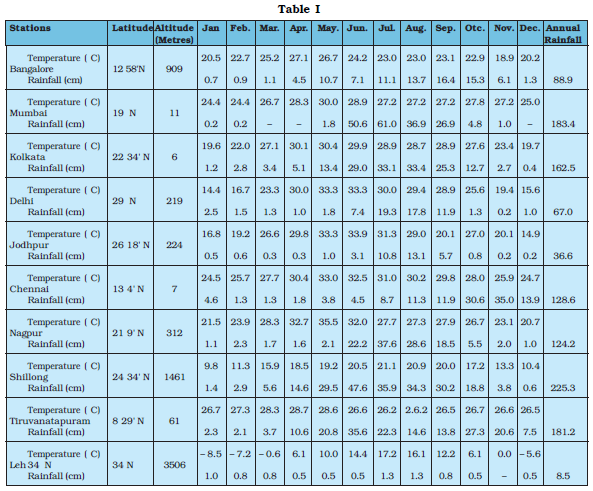
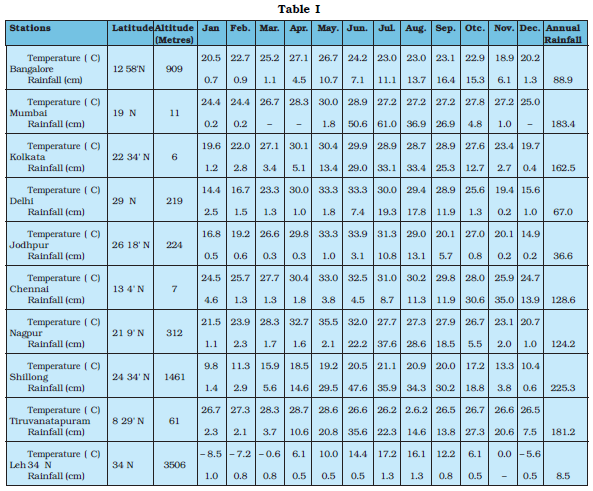
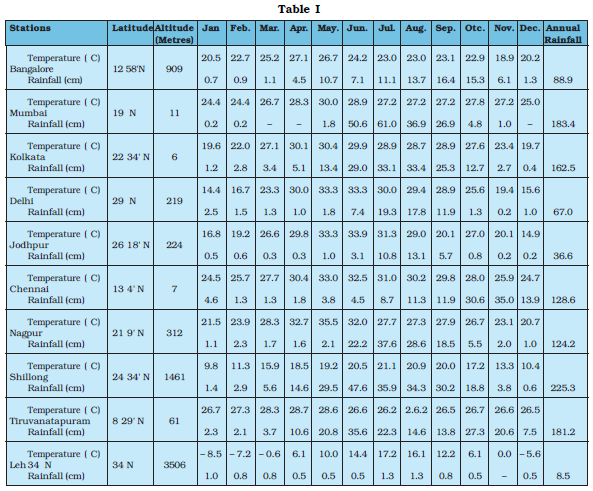
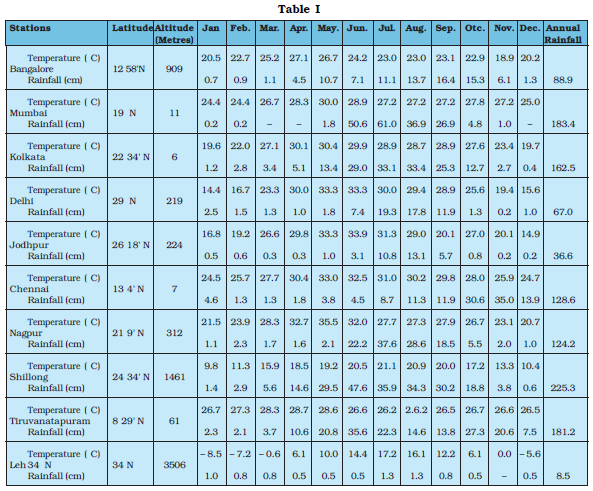
(i) Name two rainiest stations.
(ii) Name two driest stations.
(iii) Two stations with most equable climate.
(iv) Two stations with most extreme climate.
(v) Two stations most influenced by the Arabian branch of southwest monsoons.
(vi) Two stations most influenced by the Bay of Bengal branch of south-west monsoons.
(vii) Two stations influenced by both branches of the south-west monsoons.
(viii) Two stations influenced by retreating and north-east monsoons.
(ix) Two stations receiving winter showers from the western disturbances.
(x) The two hottest stations in the month of (a) February, (b) April, (c) May, (d) June.

(i) Shillong and Mumbai are the rainiest stations of India. Shillong is a hill station in northeast India and capital of the state of Meghalaya. It’s known for the manicured gardens at Lady Hydari Park. Mumbai is a densely populated city on India’s west coast. A financial center, it's India's largest city. The city's also famous as the heart of the Bollywood film industry.
(ii) Leh and Jodhpur are the driest stations of India. Leh, a high-desert city in the Himalayas, is the capital of the Leh region in northern India’s Jammu and Kashmir state. Jodhpur is a city in the Thar Desert of the northwest Indian state of Rajasthan.
(iii) Thiruvananthapuram and Chennai have equable climate. Thiruvananthapuram is the capital of the southern Indian state of Kerala. Chennai is located on the Bay of Bengal in eastern India, is the capital of the state of Tamil Nadu.
(iv) Jodhpur and Delhi have most extreme stations.
(v) Mumbai and Thiruvanthapuram. The total area of Mumbai is 603 sq. km and the usual weather is 29°C, with an average humidity of about 79%. The total areas of Thiruvanthapuram is 214 sq. km. Thiruvanthapuram doesn’t have much variation in the climate. In summer the maximum temperature goes up to 35°C and minimum reaches to 22°C. The place is extremely humid in summers.
(vi) Kolkata and Shillong. In the month of June Kolkata receives rain from the Bay of Bengal and in the month of July, the rainfall is influenced by the Arabian Sea branch. However, Shillong receives rainfall from only Bay of Bengal branch only.
(vii) Delhi and Kolkata. Due to their geographic location, both Delhi and Kolkata are influenced by both the branches of south-west monsoons. When the monsoon is influenced by the Bay of Bengal branch, these stations receive more rainfall as compared to the Arabian Sea branch.
(viii) Chennai and Bengaluru. During the retreat and north-east monsoon, cities of Southern India receive rainfall as they do not get much rainfall during the normal south-west monsoon. The north eastern monsoon takes place from December to March when the surface high-pressure system is strong.
(ix) Delhi and Jodhpurare the cities that receive winter showers due to western disturbances. Western Disturbances are important for the development of the Rabi crop, which includes the locally important staple wheat. Western disturbances originate in the Mediterranean region. An average of four to five western disturbances takes place during the winter season. The rainfall distribution and amount varies with every western disturbance.
(x) (a) February: Thiruvananthapuram and Mumbai.
(b) April: Nagpur and Chennai.
(c) May: Nagpur and Jodhpur.
(d) June: Nagpur and Delhi.
Couldn't generate an explanation.
Generated by AI. May contain inaccuracies — always verify with your textbook.