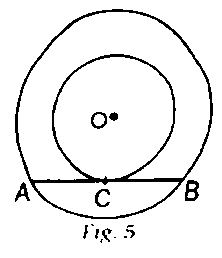
Tangents PA and PB are drawn from an external point P to two concentric circle with centre O and radii 8 cm and 5 cm respectively, as shown in Fig. 3. If AP = 15 cm, then find the length of BP.

Given that: AP = 15 cm, AO = 8 cm and OB = 5cm
The diagram is given below:

Since, AP and BP are tangents to the outer and inner circle respectively, this implies that ∠OAP = ∠OBP = 90°.
To find PB, we can first find OP by right angle triangle AOP.
So in ∆AOP, by Pythagoras theorem
(hypotenuse)2 = (base)2 + (perpendicular)2
⇒ (OP)2 = (AO)2 + (AP)2
⇒ (OP)2 = (8)2 + (15)2
⇒ (OP)2 = 64 + 225 = 289
⇒ OP = √289
⇒ OP = 17
Thus, we get OP = 17 cm.
Now in ∆BOP, by Pythagoras theorem
(hypotenuse)2 = (base)2 + (perpendicular)2
⇒ (OP)2 = (OB)2 + (BP)2
⇒ (BP)2 = (OP)2 – (OB)2
⇒ (BP)2 = (17)2 – (5)2
⇒ (BP)2 = 289 – 25 = 264
⇒ BP = √264
⇒ BP = 2√66
Hence, we get BP = 2√66.
Couldn't generate an explanation.
Generated by AI. May contain inaccuracies — always verify with your textbook.