
A cone of maximum size is carved out from a cube of edge 14 cm. Find the surface area of the remaining solid after the cone is carved out.
We have
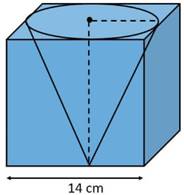
Given: length of the edge of cube = 14 cm.
A cone of maximum size is carved out from a cube.
Surface Area of the remaining solid is given by,
Surface Area of the remaining solid = Area of the cube + Curved Surface Area of the cone – Base area of the cone …(i)
First, let’s find area of cube. It is given by,
Area of cube = 6 (side)2
= 6 (14)2 [∵ side = 14 cm, as given]
= 6 × 196
= 1176 cm2 …(ii)
Now, we need to find curved surface area of cone.
For curved surface area of cone, we have
Radius of cone (r) = 7 cm [∵ diameter of cone = length of edge of the cube ⇒ radius of cone = 1/2 × diameter of cone]
Height of cone (h) = 14 cm [∵ height of cone = length of edge of cube = 14 cm]
Slant length of cone (l) = ?
Slant length of cone is given by √(r2 + h2)
⇒ l = √(r2 + h2)
⇒ l = √(72 + 142)
⇒ l = √(49 + 196)
⇒ l = √245
⇒ l = 7√5
Slant length of cone (l) = 7√5 cm
Curved surface area of cone = πrl
= 22/7 × 7 × 7√5
= 154√5 cm2 …(iii)
Now, we need to find area of base of the cone.
The base is a solid circle, we have
Radius of base (R) = 7 cm [∵ radius of base = radius of cone = 7 cm]
Area of base of cone = Area of circle = πR2
⇒ Area of base of cone = 22/7 × 72
= 154 cm2 …(iv)
Substituting values of equations (ii), (iii) & (iv) in equation (i), we get
Surface Area of the remaining solid = 1176 + 154√5 – 154 = 1022 + 154√5
Hence, Surface Area of remaining solid = (1022 + 154√5) cm2
Couldn't generate an explanation.
Generated by AI. May contain inaccuracies — always verify with your textbook.

