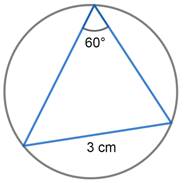
Calculate the area of the triangle shown.

Let ABC be the required triangle.
Draw perpendicular from AS on BC.

Let AS = x cm.
In Δ BAS,
∠ABS + ∠BAS + ∠ASB = 180°
⇒ 45° + ∠BAS + 90° = 180°
⇒ ∠BAS = 45°
⇒ Δ BAS is an isosceles triangle.
∴ AS = BS = x cm
BC = BS + CS = 4 cm
⇒ x + CS = 4 cm
⇒ CS = (4–x) cm

In Δ CAS,
∠ACS + ∠CAS + ∠ASC = 180°
⇒ 60° + ∠CAS + 90° = 180°
⇒ ∠CAS = 30°
We know that sides of any triangle of angles 30°, 60° and 90°
are in the ratio 1: √3: 2 .
⇒ CS :AS: AC = 1: √3: 2
⇒ (4-x) :x : AC = 1: √3 :2
⇒ (4 - x) : x = 1 : √3 ⇒ √3(4 - x) = x
⇒ 4√3 - x√3 = x
⇒ x(√3 + 1) = 4√3

Multiplying and Dividing by (√3 - 1)


⇒ x = 2(√3 - 1) cm
In Δ BAC,
Height = x = 2(√3 - 1) cm and Base = 4 cm


Area (Δ) = 4(√3 - 1) cm2 = 10.92 cm2
Couldn't generate an explanation.
Generated by AI. May contain inaccuracies — always verify with your textbook.