
If y=e–x cos x, show that :  sin x.
Basic idea:
√Second order derivative is nothing but derivative of derivative i.e. 
√The idea of chain rule of differentiation: If f is any real-valued function which is the composition of two functions u and v, i.e. f = v(u(x)). For the sake of simplicity just assume t = u(x)
Then f = v(t). By chain rule, we can write the derivative of f w.r.t to x as:
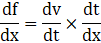
√Product rule of differentiation- 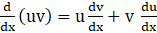
√Apart from these remember the derivatives of some important functions like exponential, logarithmic, trigonometric etc..
Let’s solve now:
Given,
y=e–x cos x
TO prove :
 sin x.
Clearly from the expression to be proved we can easily observe that we need to just find the second derivative of given function.
Given, y = e–x cos x
We have to find 
As, 
So lets first find dy/dx and differentiate it again.
∴ 
Let u = e–x and v = cos x
As, y = u*v
∴ using product rule of differentiation:

∴ 

[ ∵  ]
]
Again differentiating w.r.t x:


Again using the product rule :


[∵ 

Couldn't generate an explanation.
Generated by AI. May contain inaccuracies — always verify with your textbook.

