
If log y = tan–1 X, show that : (1+x2)y2+(2x–1) y1=0.
Note: y2 represents second order derivative i.e.  and y1 = dy/dx
Given,
log y = tan–1 X
∴ y =  ……equation 1
to prove : (1+x2)y2+(2x–1)y1=0
We notice a second order derivative in the expression to be proved so first take the step to find the second order derivative.
Let’s find 
As 
So, lets first find dy/dx
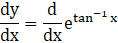
Using chain rule, we will differentiate the above expression
Let t = tan–1 x =>  [
[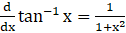 ]
]
And y = et

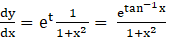 …….equation 2
Again differentiating with respect to x applying product rule:

Using chain rule we will differentiate the above expression-
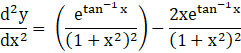
[using  &
& 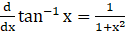 ]
]


Using equation 2 :
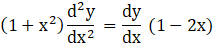
∴ (1+x2)y2+(2x–1)y1=0 ……proved
Couldn't generate an explanation.
Generated by AI. May contain inaccuracies — always verify with your textbook.


