Q21 of 26 Page 1

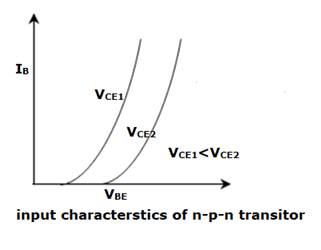
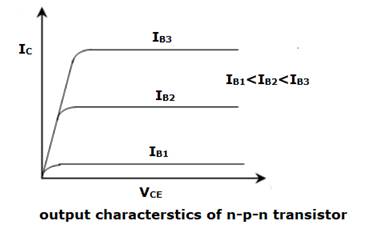
Draw the typical input and output characteristics of an n-p-n transistor in CE configuration. Show how these characteristics can be used to determine (a) the input resistance (ri), and (b) current amplification factor (β).

The input and output characteristics of n-p-n transistor in CE configuration is given below:


Input resistance is defined as the ratio of change in base-emitter voltage (ΔVBE) to the change in base current (ΔIB) at a constant collector-emitter voltage.


Current amplification factor (β) is defined as the ratio of the change in the collector current to the change in the base current at a constant collector-emitter voltage when the transistor is in active state.


More from this chapter

All 26 →
19

(a) Explain the processes of nuclear fission and nuclear fusion by using the plot of binding energy per nucleon (BE/A) versus the mass number A.

(b) A radioactive isotope has a half-life of 10 years. How long will it take for the activity to reduce to 3.125% ?

20

(a) A student wants to use two p-n junction diodes to convert alternating current into direct current. Draw the labelled circuit diagram she would use and explain how it works.

(b) Give the truth table and circuit symbol for NAND gate.

22

(a) Give three reasons why modulation of a message signal is necessary for long distance transmission.

(b) Show graphically an audio signal, a carrier wave and an amplitude modulated wave.

23

The teachers of Geeta’s school took the students on a study trip to a power generating station, located nearly 200 km away from the city. The teacher explained that electrical energy is transmitted over such a long distance to their city, in the form of alternating current (ac) raised to a high voltage. At the receiving end in the city, the voltage is reduced to operate the devices. As a result, the power loss is reduced. Geeta listened to the teacher and asked questions about how the ac is converted to a higher or lower voltage.

(a) Name the device used to change the alternating voltage to a higher or lower value. State one cause for power dissipation in this device.


(b) Explain with an example, how power loss is reduced if the energy is transmitted over long distances as an alternating current rather than a direct current.


(c) Write two values each shown by the teachers and Geeta.