
In any Δ ABC,  then prove that
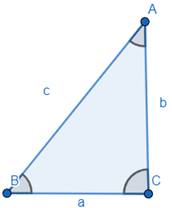
Note: In any ΔABC we define ‘a’ as the length of the side opposite to ∠A, ‘b’ as the length of the side opposite to ∠B and ‘c’ as the length of the side opposite to ∠C.
The key point to solve the problem:
The idea of cosine formula in ΔABC
• Cos A = 
• Cos B = 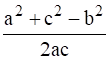
• Cos C = 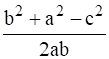
As we have to prove 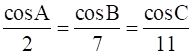 under given conditions.
∵ Only cos terms are involved so we will apply cosine formula to find cos A , cos B, and cos C and we will take their ratio.
∵ 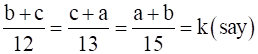
∴ b + c = 12k ….eqn 1
c + a = 13k ….eqn 2
a + b = 15k ….eqn 3
But only above relation is not sufficient to find cosines as k is unknown, either we need to express k in terms of a , b or c or express a , b , c in terms of k. Later part is easier.
∴ we will find a,b,c in terms of k
Adding eqn 1,2 and 3 we have –
2 (a + b + c) = 40k
∴ a + b+ c = 20k
∴ a = 20k – (b + c) = 20k – 12k = 8k
Similarly, b = 20k – (c + a) = 20k – 13k = 7k
And c = 20k – (a + b) = 20k – 15k = 5k
Hence,
Cos A = 
Cos B = 
cos C = 
∴ 
∴ 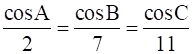 ….Hence proved.
Couldn't generate an explanation.
Generated by AI. May contain inaccuracies — always verify with your textbook.

