Solution of Chapter 2. Polynomials (NCERT - Mathematics Book)
Chapter Exercises
Exercise 2.1
Which of the following expressions are polynomials in one variable and which are not? State reasons for your answer
(i)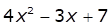
(ii)
(iii)
(iv)
(v)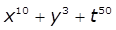
Write the coefficients of x2 in each of the following:
(i) 
(ii) 
(iii) 
(iv) 
Give one example each of a binomial of degree 35, and of a monomial of degree 100.
view answer >Write the degree of each of the following polynomials:
(i) 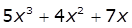
(ii) 
(iii) 
(iv) 
Classify the following as linear, quadratic and cubic polynomials:
(i) x2 + x
(ii) x – x3
(iii) y + y2 + 4
(iv) 1 + x
(v) 3t
(vi) r2
(vii) 7x3
view answer >Exercise 2.2
Find the value of the polynomial 5x – 4x2 + 3 at
(i) x = 0
(ii) x = –1
(iii) x = 2
view answer >Find p(0), p(1) and p(2) for each of the following polynomials:
(i) 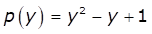
(ii) 
(iii) 
(iv) 
Verify whether the following are zeroes of the polynomial, indicated against them.
(i) 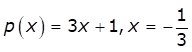
(ii) 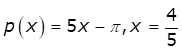
(iii) 
(iv) 
(v) 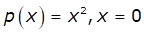
(vi) 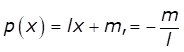
(vii)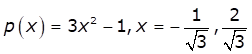
(viii)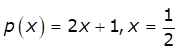
Find the zero of the polynomial in each of the following cases:
(i) 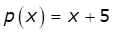
(ii) 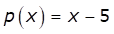
(iii) 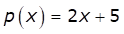
(iv) 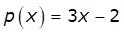
(v) 
(vi) 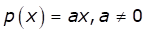
(vii) are real numbers.
Exercise 2.3
Find the remainder when  is divided by
(i) 
(ii) 
(iii) 
(iv) 
(v) 
Find the remainder when  is divided by
Check whether  is a factor of
Exercise 2.4
Determine which of the following polynomials has (x + 1) a factor:
(i) 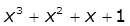
(ii) 
(iii) 
(iv) 
Use the Factor Theorem to determine whether g(x) is a factor of p(x) in each of the following cases:
(i) 
(ii)
(iii) 
Find the value of k, if  is a factor of p(x) in each of the following cases:
(i) 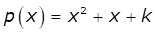
(ii) 
(iii) 
(iv) 
Factorize:
(i) 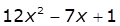
(ii) 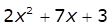
(iii) 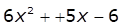
(iv) 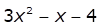
Factorize:
(i) 
(ii) 
(iii) 
(iv) 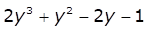
Exercise 2.5
Use suitable identities to find the following products:
(i) (x + 4) (x + 10)
(ii) (x + 8) (x - 10)
(iii) (3x + 4) (3x - 5)
(iv) 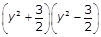
(v) (3 - 2x) (3 + 2x)
view answer >Evaluate the following products without multiplying directly:
(i) 
(ii) 
(iii) 
Factorize the following using appropriate identities:
(i) 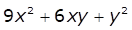
(ii) 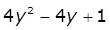
(iii) 
Expand each of the following, using suitable identities:
(i) 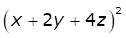
(ii) 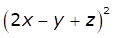
(iii) 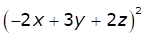
(iv) 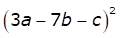
(v) 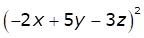
(vi)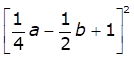
Factorize:
(i) 
(ii) 
Write the following cubes in expanded form:
(i) 
(ii) 
(iii) 
(iv) 
Evaluate the following using suitable identities:
(i) 
(ii) 
(iii) 
Factorize each of the following:
(i) 
(ii) 
(iii) 
(iv) 
(v) 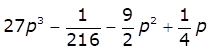
Verify:
(i) 
(ii) 
Factorize each of the following:
[Hint: See Question 9]
(i) 27y3 + 125z3
(ii) 64m3 – 343n3
view answer >Factorize:
Verify that:
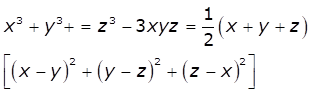
If x + y + z = 0, show that x3 + y3 + z3 = 3xyz.
view answer >Without actually calculating the cubes, find the value of each of the following:
(i) 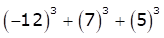
(ii) 
Give possible expressions for the length and breadth of each of the following rectangles, in which their areas are given:
(i) Area : 25a2 – 35a + 12
(ii) Area : 35y2 + 13y – 12
view answer >What are the possible expressions for the dimensions of the cuboids whose volumes are given below?
(i) Volume : 3x2 – 12x
(ii) Volume : 12ky2 + 8ky – 20k
view answer >