If  , then write the value of (x, y).
We are given that,

We need to find the value of (x, y).
Multiply the matrices on the right hand side of the equation,

For z11: Dot multiply the 1st row of first matrix and 1st column of second matrix, then sum up.
(2 1)(1 -2) = 2 × 1 + 1 × -2
⇒ (2 1)(1 -2) = 2 – 2
⇒ (2 1)(1 -2) = 0
So,

For z21: Dot multiply the 2nd row of first matrix and 1st column of second matrix, then sum up.
(4 3)(1 -2) = 4 × 1 + 3 × (-2)
⇒ (4 3)(1 -2) = 4 – 6
⇒ (4 3)(1 -2) = -2
So,

Equate the resulting matrix to the given matrix equation.

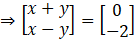
We know by the property of matrices,
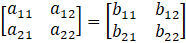
This implies,
a11 = b11, a12 = b12, a21 = b21 and a22 = b22
Therefore,
x + y = 0
x – y = -2
Adding these two equations, we get
(x + y) + (x – y) = 0 + (-2)
⇒ x + y + x – y = -2
⇒ x + x + y – y = -2
⇒ 2x + 0 = -2
⇒ 2x = -2

⇒ x = -1
Putting x = -1 in
x + y = 0
⇒ (-1) + y = 0
⇒ -1 + y = 0
⇒ y = 1
So, putting values of x and y from above in (x, y), we get
(x, y) = (-1, 1)
Thus, (x, y) is (-1, 1).
Couldn't generate an explanation.
Generated by AI. May contain inaccuracies — always verify with your textbook.