Skip to content
Philoid
Browse Saved
Back to chapter
Maths
13. Derivative as a Rate Measurer
Home · Class 12 · Maths · Ref. Book · 13. Derivative as a Rate Measurer
Prev
Next
Q17 of 78 Page 13

Mark the correct alternative in the following:

Each side of an equilateral triangle is increasing at the rate of 8 cm/hr. The rate of increase of its area when side is 2 cm, is


The area of an equilateral triangle, with side a, is defined as

– (1)


Given that and a=2cm, we have to calculate


Differentiating (1) with respect to t, we get
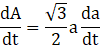


Substituting the values, we get


More from this chapter

All 78 →
15

Mark the correct alternative in the following:

If the rate of change of volume of a sphere is equal to the rate of change of its radius, then its radius is equal to


16

Mark the correct alternative in the following:

If the rate of change of area of a circle is equal to the rate of change of its diameter, then its radius is equal to


18

Mark the correct alternative in the following:

If s = t3 – 4t2 + 5 describes the motion of a particle, then its velocity when the acceleration vanishes, is


19

Mark the correct alternative in the following:

The equation of motion of a particle is s = 2t2 + sin 2t, where s is in metre and t is in seconds. The velocity of the particle when its acceleration is 2m/sec2, is


Questions · 78
13. Derivative as a Rate Measurer
1 2 3 4 5 6 7 8 9 10 1 2 3 4 5 6 7 8 9 10 11 12 13 14 15 16 16 17 18 19 20 21 22 23 24 25 26 27 28 29 30 31 1 2 3 4 5 6 7 8 9 10 11 12 13 14 15 16 17 18 19 20 21 22 23 24 25 26 1 2 3 4 5 6 7 8 9 10
Back to chapter
About Contact Privacy Terms
Philoid · 2026
  • Home
  • Search
  • Browse
  • Quiz
  • Saved