Mark the correct alternative in the following:
If s = t3 – 4t2 + 5 describes the motion of a particle, then its velocity when the acceleration vanishes, is
If we are given the distance travelled(s) as a function of time, we can calculate velocity(v) and acceleration(a) by
 and a
and a
s(t)= t3 – 4t2 + 5
differentiating w.r.t. time, we get
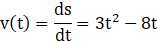
Differentiating again w.r.t. time, we get
a
Given that a=0 ⇒ 6t-8=0 or  units
units

AI is thinking…
Couldn't generate an explanation.
Generated by AI. May contain inaccuracies — always verify with your textbook.